‘Missing middle’ medium density just ain’t happening – we need to talk about retrofitting suburbia instead of replacing it
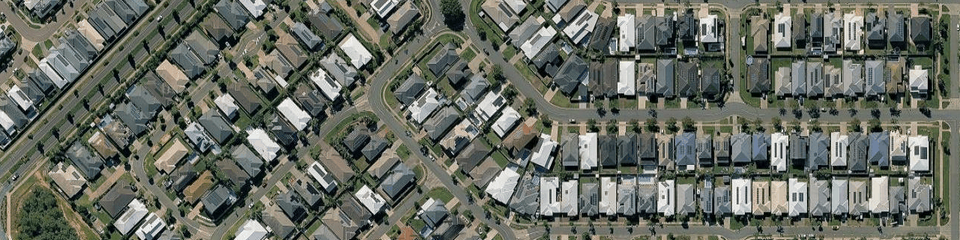
Recently, Brisbane City Council announced it’ll amend its City Plan to make it easier for some residential blocks to be subdivided into smaller 120m2 lot sizes, and allow three-storey apartment blocks in more locations across suburbia.
As someone who has lived in a tiny house with a footprint of just 23m2 (and also in a 13.5m2 houseboat), I know it’s possible to design compact, high-quality homes on small lots that leave room for nature around the edges.
But BCC’s development assessment processes aren't strong enough to enforce minimum green space requirements, meaning that in practice, many new houses on these small subdivided lots will be built right up to the boundaries, with excessively large building footprints, poor airflow, and much less room for trees, veggie gardens or outdoor recreation.
The announcement seems like a gift for property speculators, as it'll put further upward pressure on residential land values long before any additional homes are actually built.
These edge-tinkering planning code changes are the council's latest weak attempt to address a major challenge that cities like Brisbane have been grappling with for years...
We have thousands of hectares of existing low-density suburban sprawl neighbourhoods where most people are stuck driving private cars for transport, where we use up huge areas of land to house and feed relatively small numbers of people, and where many residents lead atomised lives with negligible community connection.
In fact, Brisbane holds the dubious honour of being one of the lowest-density cities in the world. Consequently, most of the relevant local councils are running severe budget deficits; in low-density suburbs, the costs of building and properly maintaining infrastructure like roads and stormwater drains, or providing services like weekly rubbish collection, far exceed council rates revenue.
But key planning documents – such as the State Government's latest regional plan, ShapingSEQ 2023 – don't propose a substantially different trajectory for existing low-density suburbs, and in fact still support more low-density suburban sprawl development going forward. The regional plan anticipates that even by 2046, for the five local government areas within Greater Brisbane, the vast majority of dwellings will remain low-density detached homes.
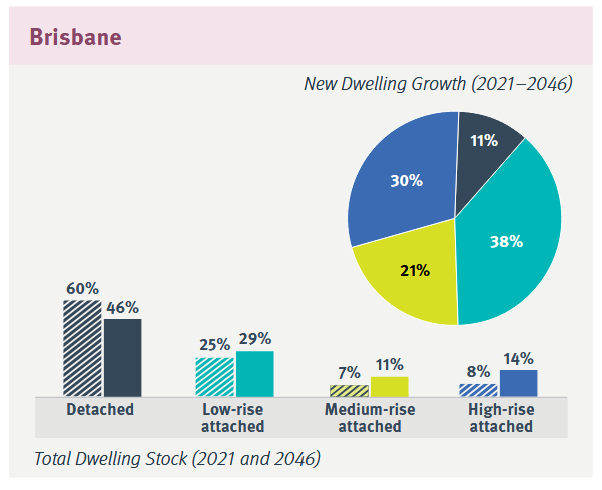
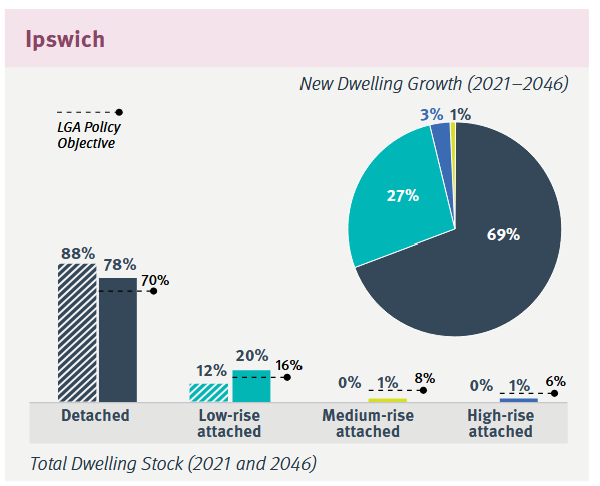
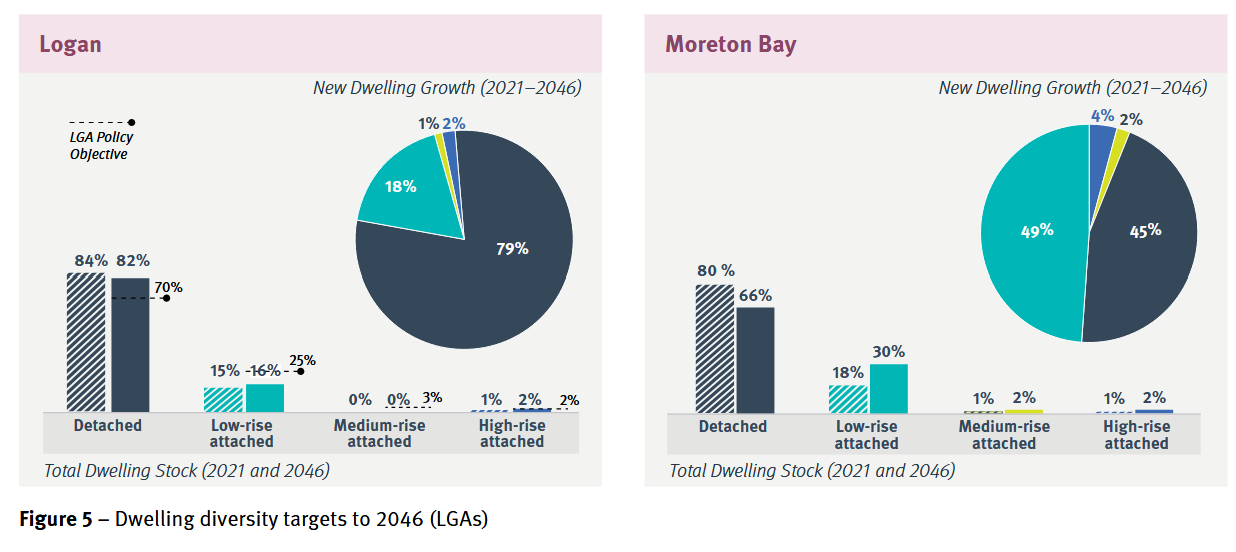
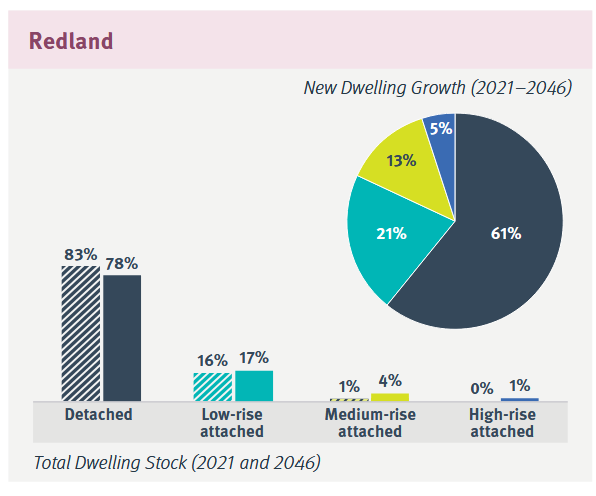
The Shaping SEQ Regional Plan 2023 does call for a modest shift in dwelling diversity, with higher rates of medium-density and high-density development (particularly within the Brisbane City Council LGA), but overall, the plan anticipates that there will be even more low-density suburban sprawl housing in 2046 than there is today
Suburban sprawl will continue to lock most Brisbane residents into a life of traffic jams, car dependence and inadequate local access to public services and facilities, while lumping governments with the unsustainable and ever-increasing financial burden of infrastructure maintenance.
Major improvements to public transport would of course help reduce car dependency (and road infrastructure costs), particularly in Brisbane's middle suburbs. But residents' destinations and times of travel are extremely varied – not everyone is a 9-to-5, Mon-Fri CBD office-worker. Providing the level of 7 day/week public transport coverage and frequency required to entice the majority of suburbanites out of their cars simply isn't viable in sparsely-populated outer-suburban neighbourhoods. We either need to bring key travel destinations closer to where people live, or increase suburban population densities – ideally a bit of both.
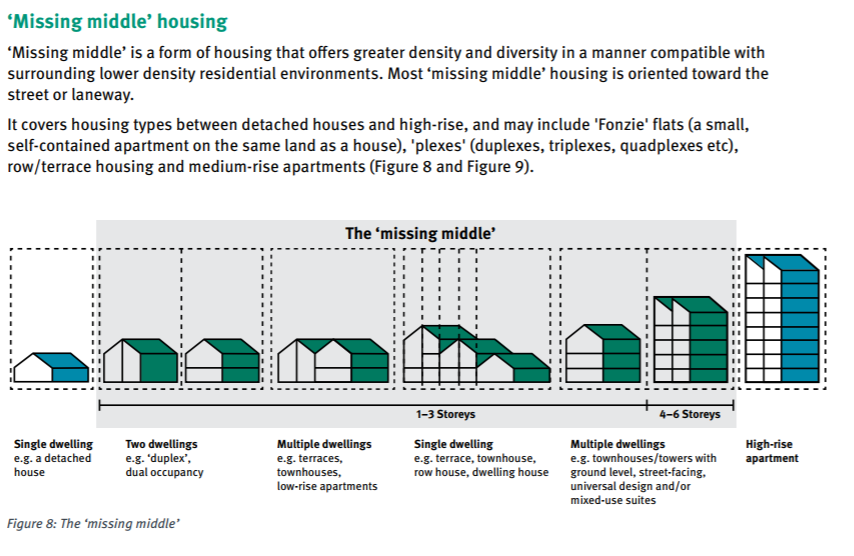
The main response that progressive planners, advocacy groups and political parties like the Greens (to some extent) have offered is ‘missing middle’ development – medium-density housing such as townhouses and apartment blocks of around 3 to 5 storeys...
Restrictive planning controls limiting where developers can build missing middle housing are also being blamed for rising housing costs (I think this is partly a distraction from the main culprits – regressive tax laws that encourage investors to hoard homes for profit, and cuts to public housing programs).
This rhetoric that we need to relax zoning rules to facilitate more medium-density development has been widely adopted by everyone from property industry groups who want house prices (and thus profits) to keep rising, to progressive lobby groups who want to improve affordability and deprioritise car-based transport.
Personally I like medium-density housing, as long as it’s well-designed, supported by good public transport and sufficient local public services and facilities, and leaves plenty of room for green space. As a city councillor, I spent a lot of time calling for medium-density public housing projects around suburban train stations and employment hubs, and I wish there was lots more of it in Brisbane.
I’ve been inspired by design approaches like Nightingale Housing, which builds medium-density apartment blocks close to public transport stations, with communal facilities like laundries, and no on-site carparking. Even cooler are models like Stucco Housing Co-Op, which take the communal element a step further and encourage residents to participate in democratic decision-making about their shared facilities.
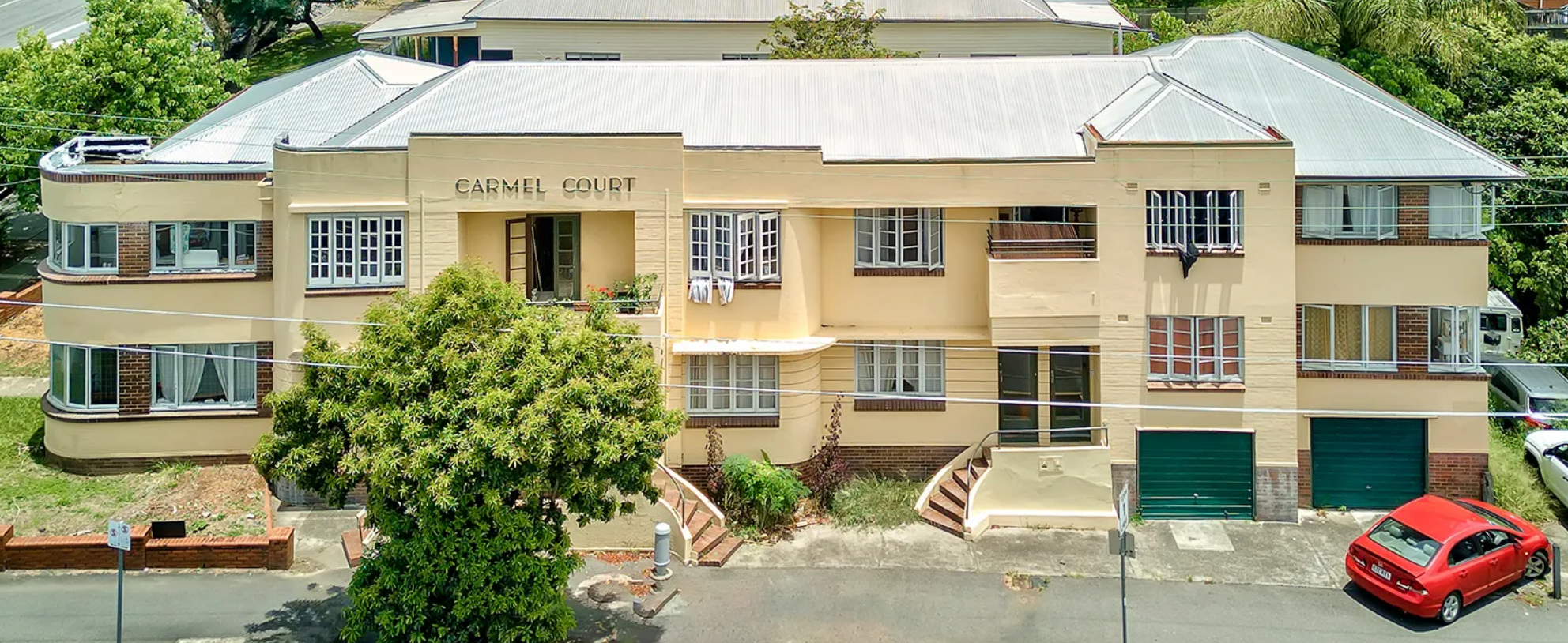
Some of my favourite medium-density homes are the older walk-up flats that don't waste much space on carparking and still preserve a bit of shared yard space (rather than building right up to property boundaries).
But while medium-density apartment developments are a good thing to advocate for, particularly on larger sites that are redeveloping anyway (e.g. old warehouses), I’ve come to the reluctant conclusion that they’re not, by themselves, a viable answer to the problems of Brisbane’s existing suburban sprawl. The evidence for this is pretty straightforward...
Medium-density development isn’t happening fast enough
Even in neighbourhoods where medium-density apartments and townhouses have been permitted for years now, comparatively few have been built. There are literally thousands of properties across the Brisbane Local Government Area that are already zoned LMR ('low-medium-density residential'), MDR ('medium-density residential' – up to five storeys) or MU ('Mixed use' – combination of shops/offices and residential apartments), where it’s relatively easy to secure council approval to build a new 3-storey apartment block. But most of these sites remain low-density free-standing houses.
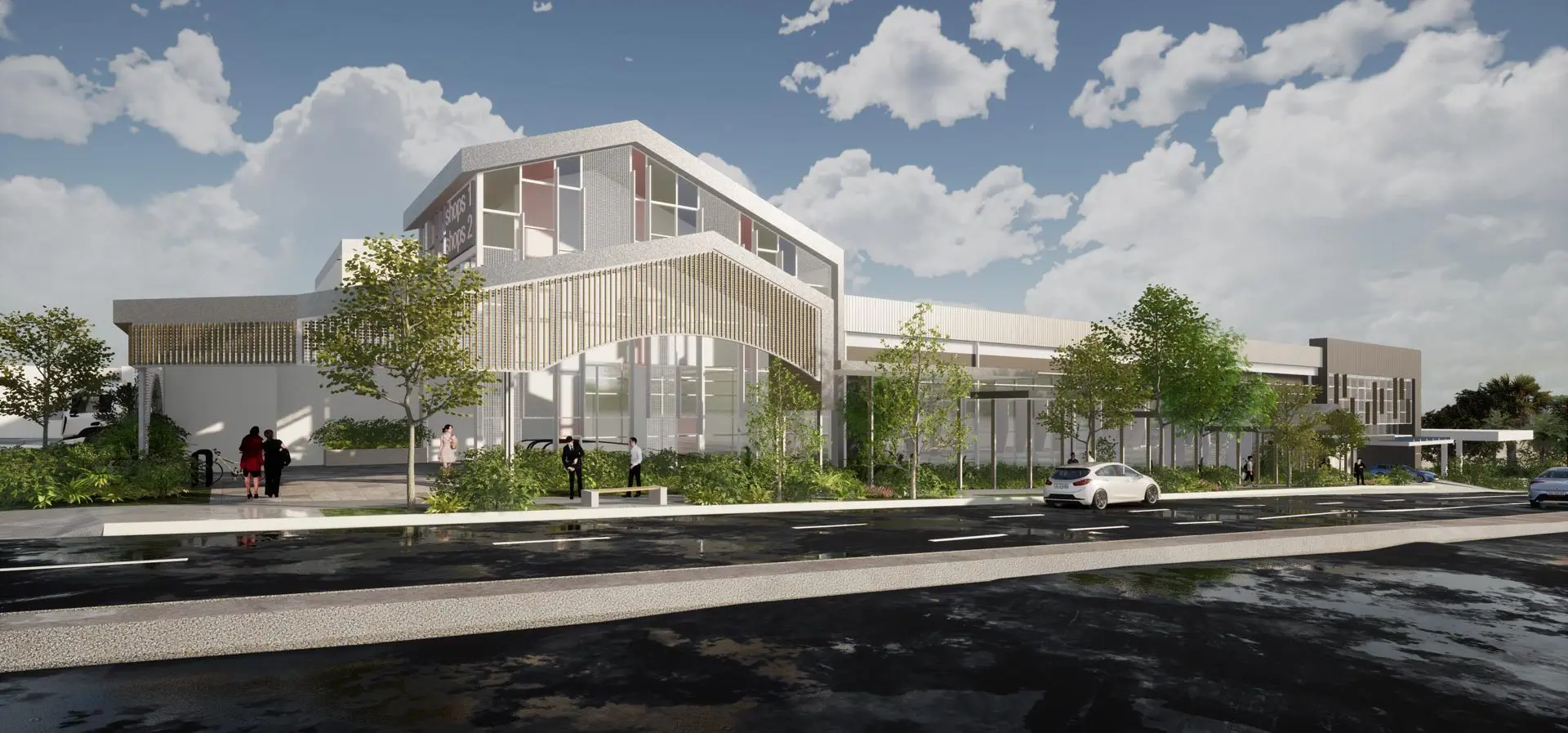
Meanwhile, key LMR-zoned sites are being approved for non-residential uses. Take, for example, the 6700m2 site at 800 Ipswich Rd, Annerley. Located along a major transport corridor with high-frequency bus services, across the road from a large public park and a short walk from public schools, it’s a great candidate for mixed-used medium-density development with shops and restaurants at ground level and apartments above.
But despite the LMR zoning, guess what’s being built there? A low-rise Coles and Liquorland with no residential apartments, and a design focus on customers travelling by car.
Brisbane City Council has suggested that across its entire local government area, we're now seeing fewer than 500 dwellings completed per year in the LMR zone – nowhere near the pace we need if we’re relying on new-build apartments to drive the transformation of suburbia. Building a few thousand medium-density apartments along suburban arterial roads doesn't really address the broader underlying problems of suburban sprawl.
Right now in the Brisbane City Council LGA, there are over 290 000 detached residential homes, most of which are on blocks greater than 400m2 – essentially a low-density built form. If we include the neighbouring local councils of Ipswich, Moreton Bay, Redlands and Logan (where many of the problems of suburban sprawl – particularly commute times – are even worse), we’re talking upwards of 700 000 detached homes in total.
So even if there were a significant acceleration in the rate of medium-density residential construction (and most signs are suggesting a deceleration is more likely), it would take decades and decades to replace even a fraction of Brisbane’s low-density suburban sprawl built form with ‘missing middle’ townhouses and apartments.
The State Government's regional plan at least seems to acknowledge this mathematical reality, but the power-holders who shape our city aren't grappling with the ramifications.
While I’m not denying that planning restrictions (including minimum carparking requirements) might be having some partial impact, it’s naive and simplistic to argue that zone codes and overlays are the main reason we’re not seeing more medium-density housing construction in Brisbane, despite the obvious demand.
Heaps of different factors limit missing middle apartment development – not just planning restrictions
New-build medium-density projects in suburbia face numerous challenges, whether delivered by governments, non-profit community housing providers, or private developers. Even once you’ve worked out how to squeeze in wide enough driveways and access points for garbage trucks etc., the costs and difficulties of upgrading existing infrastructure like sewage lines and electricity substations can be significant.
You often also need to combine adjoining blocks to create a large enough development footprint – particularly if you want well-designed apartments that still have some green space around the edges (rather than windows looking straight into the windows of neighbouring apartments). But most existing home-owners aren’t in a hurry to sell and move.
As much as some private developers might wish otherwise, you can't realistically force tens of thousands of suburban owner-occupiers to move out against their will just so you can demolish their homes and replace them with apartments.
As University of Queensland researchers have repeatedly highlighted, 'parcel amalgamation’ is extremely difficult. And with councils like BCC permitting and encouraging more subdivisions into smaller lots, it's getting even harder to secure sites that are large enough for a decent medium-density apartment complex.
If Brisbane seriously attempted to densify whole suburbs through demolition and redevelopment, the cumulative quality-of-life construction impacts on neighbours – such as noise pollution, air pollution and site traffic – would also become far bigger issues than most policy-makers acknowledge. If we were talking about a single, one-off construction project, maybe asking residents to toughen up and bear it for a couple months would be reasonable. But suburban renewal models that progressively demolish and replace one home after another – and where a medium-density apartment block can easily take 18+ months to build – mean sentencing a neighbourhood to ongoing, disruptive construction impacts for a decade or more.
All the while, construction costs in terms of labour and materials are rising. As the climate becomes increasingly unsustainable, more days of outdoor construction work will be lost to severe heat and storms. And the cost of transporting building materials – particularly from overseas – will continue climbing substantially.
Maybe there are parts of Australia where dramatic increases in apartment construction rates are possible, but South-East Queensland's existing suburban conurbation isn't one of them. As banks and insurers start accurately pricing in the risk of climate disasters and associated construction delays, mass construction of townhouse and apartment projects within existing low-density suburbs is going to seem like a pipe dream.
This is both a financial challenge and an environmental one. Demolishing hundreds of thousands of existing houses to replace them with apartments or townhouses is hugely wasteful in terms of embodied energy and construction materials. In terms of the land it takes up, a three-storey block of twelve units certainly has a lower environmental impact than twelve detached houses on 400m2 blocks. But it still uses a lot of concrete and steel, and unlike detached homes, generally won’t have enough roof space to generate solar energy on-site for all its residents, or enough yard space to compost food waste (and thus reduce off-site garbage disposal costs).
I’m definitely not anti-missing middle housing. But sustainable development advocates need to face a hard truth: relying primarily on new-build medium-density apartments is not a realistic pathway to transition the bulk of Greater Brisbane suburbia away from car dependence, fossil fuel dependence and inefficient, low-density land uses.
In short, there are already way too many existing low-density suburban homes – knocking them down and replacing them with medium-density housing would take generations.
Basically, we're stuck with suburbia. But our political leaders have no credible proposal for how we transform our existing suburbs to resolve the deep problems of conventional suburban sprawl.
What should we do instead?
Fortunately there’s another path forward – an alternative, collaboratively-concocted vision for a greener, more sustainable suburbia, already being implemented not so much by urban planners, architects and developers, but by permaculture hippies and DIY punks. It’s a more realistic and achievable approach, because it circumvents major barriers to traditional new-build apartment construction, while still increasing density somewhat and eliminating many of the negative environmental and social impacts of orthodox suburban living.
We might think of it as adapting or retrofitting the suburban built form rather than replacing it altogether.
I think permaculture pioneer David Holmgren gets to claim credit for popularising the term ‘retrosuburbia,’ but many other Australian thinkers, such as Brendan Gleeson and Samuel Alexander (authors of ‘Degrowth in the Suburbs’) have also been charting new ground on this front.
Making better use of existing housing stock
Across the Greater Brisbane region, the 2021 Census reported an average of 3.3 bedrooms per dwelling but only 2.6 residents per dwelling; the impending 2026 Census will likely show we’re still following the same trend of household sizes shrinking faster than average dwelling sizes. Brisbane today has hundreds of thousands of spare bedrooms.
Not everyone wants to or needs to live in a sharehouse. But leaving apartments and townhouses aside, if just 1 in every 4 of the 700 000 detached homes in our region could accommodate an additional person, Greater Brisbane could house 175 000 extra residents before we built even a single new home (while still preserving an over-abundance of spare bedrooms for guests, home offices etc). This doesn’t necessarily mean a full 25% of households need take on an extra paying tenant; it also means using tax and rates incentives to discourage investors from leaving properties empty, and supporting empty-nesters who live in 4 and 5-bedroom houses (but who aren’t yet ready to give up their backyard altogether) to at least downsize into 3-bedroom houses (abolishing stamp duty on housing would be a good start).
Beyond this, we can also house hundreds of thousands more residents through building tiny houses and modular granny flats off-site and squeezing them into backyards, without the need to demolish existing houses.
From the perspectives of both cost-effective public service provision, and community connectedness, there are significant advantages to a cohousing project that puts a factory-built tiny house in a backyard (sharing services like electricity, mains water and waste collection, and facilities like laundries and parking spaces, with the main house) versus the city council’s apparently preferred approach of subdividing and selling off those backyards for freehold townhouses, so that atomised individuals have their own electricity bills, driveways, wheelie bins and exorbitant mortgages.
As well as secondary dwellings in backyards, there are the myriad opportunities of turning high-set houses into duplexes by converting garages and undercrofts into liveable flats.
Policymakers and advocates seeking to make Brisbane’s suburbs more sustainable while also housing more people should look at how residents who share those goals are themselves already adapting. They’ll find that across suburbia, people are converting existing homes so they can squeeze in friends and family members, often without the complexities of development approvals or the costs of major renovations.
Governments control numerous policy levers than can facilitate and encourage this already-in-progress low-impact transition of suburbia (far too many to list in one article)… from relaxing restrictions on home compost toilets (so that secondary dwellings don’t need to connect to trunk sewer lines), to incentivising composting of kitchen scraps (minimising council waste collection costs) to approving conversions of under-house spaces into habitable rooms, even if they’re slightly short of the 2.4-metre minimum ceiling height standards (saving owners hundreds of thousands of dollars they’d otherwise have to spend raising their old house by 30 or 40cm).
Decentralise and localise
But this isn’t just about housing more people. It’s about adapting and retrofitting whole suburbs to reduce car-dependence and shorten residents' travel distances to access common goods and services.
The low-hanging fruit for councils is to improve active transport connectivity – decent footpaths with more shade trees, separated bike lanes that are safe enough for children to ride to school on, lower speed limits, and many more zebra crossings and signalised pedestrian crossings.
Larger suburban yards, road verges and parks also hold significant potential for local food production, which reduces dependence on long, fragile corporate supply chains. The more fresh produce we can grow in our own neighbourhoods, the fewer resources our society expends on industrial monoculture farming and refrigerated transportation.
Beyond that, a green suburban evolution will take different forms depending on local contexts and needs…
If the bowls club down the road is staffed and open 6 days a week anyway, can it double as a non-profit corner store so residents have an affordable, walking-distance alternative to driving all the way to the supermarket?
Will a simple library or community hall renovation to create more co-working desk space save knowledge sector workers from having to commute into the city?
Could a modest funding injection expand the local RSL’s courtesy minibus into a cross-suburb public service that fills gaps in the government-run public transport network?
Does the sheltered area beneath the motorway overpass have potential as an outdoor art gallery?
Of the many possibilities for reimagining suburbia, one of the best return-on-effort changes in Brisbane might be to relax comically restrictive Home-based business codes...
Using big homes for more than just housing
A key reason Brisbane’s middle and outer-suburbs are so car-dependent, and often remain thus even after new apartment and townhouse projects increase a neighbourhood’s population density, is that huge expanses of Greater Brisbane are dormitory suburbs, exclusively zoned for residential use, without so much as a hairdresser, doctor’s surgery, cafe or community hall within easy walking distance of people’s homes.
Almost everyone drives to work and drives to the shops.
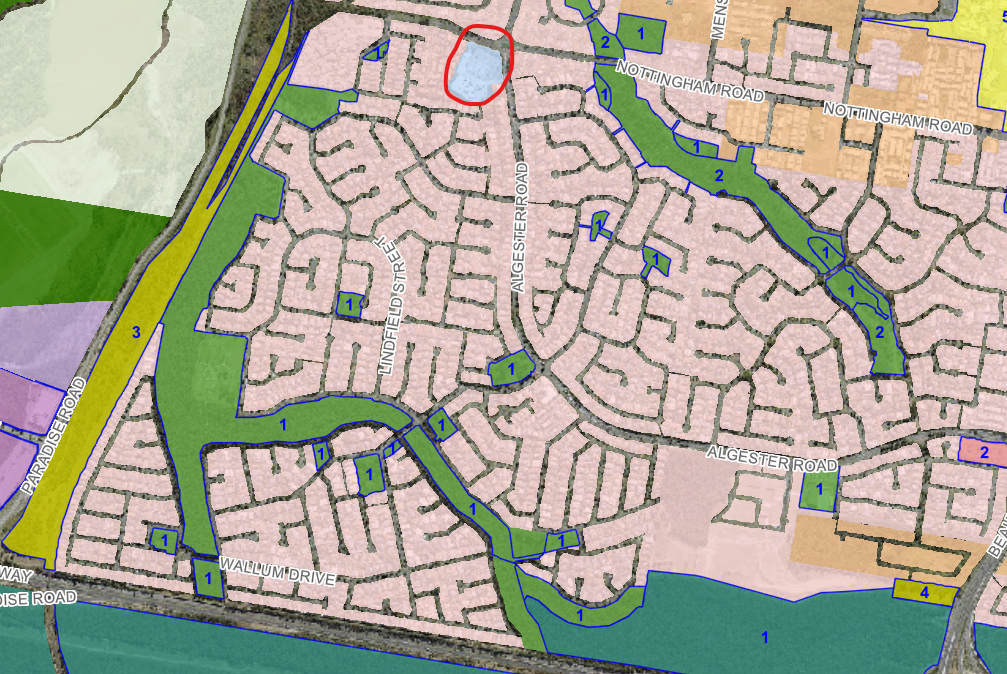
The growing popularity of suburban cafes shows the strength of resident demand for third spaces close to where people live, but very few neighbourhoods have commercially-zoned sites that enable such businesses.
Mixed-used development (with shops at ground level and units above) has always been rare outside the city’s inner-ring. There’s usually no room in an already-developed residential suburb to squeeze in a whole strip of shops and restaurants.
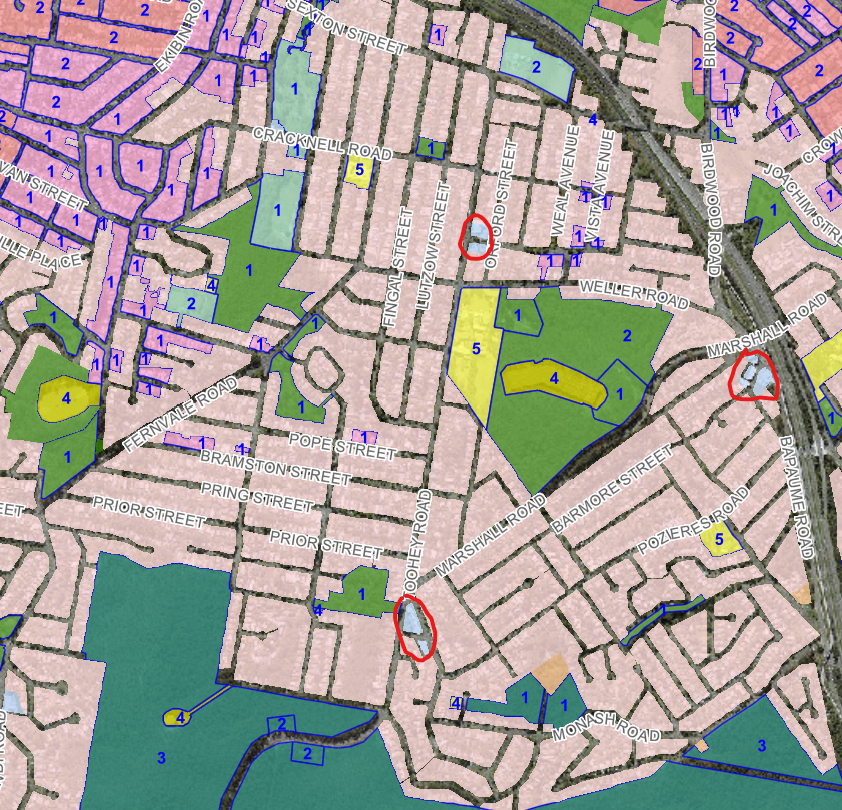
Meanwhile, Brisbane’s large suburban homes often feature a lot of under-utilised space. This can be the case even for some new townhouses and apartments that have more carparks than the residents require.
So a crucial element of adapting suburbia to be more sustainable, resilient and socially connected means exploring how we can better utilise what’s already there – garages, decks, backyards and undercrofts – to provide more services and recreational activities within residential neighbourhoods (with the caveat that some portion of the property must still be used for residential housing).
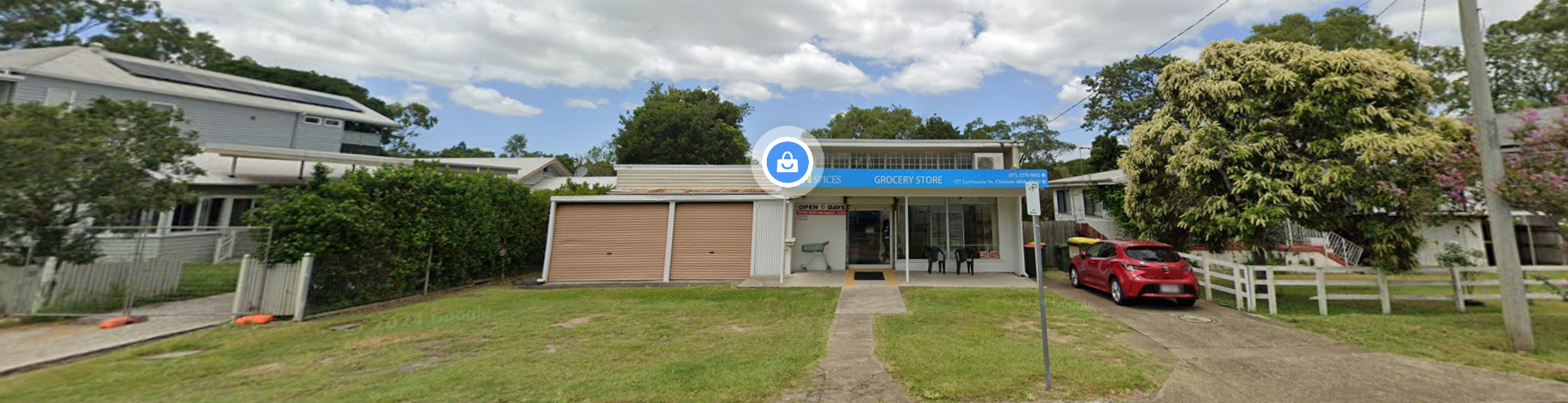
Home-based businesses can often survive off much lower customer volumes, and are more resilient to economic shocks and downturns, because a key fixed cost – physical premises – is negligible. Conveniently, the rise in middle-class professionals working from home means there are also now more potential customers remaining within suburban dormitory suburbs on an average weekday. But unnecessarily strict local government regulations rule out many kinds of businesses and community services from operating in the suburbs.
Brisbane City Council’s current rules limit home businesses to a maximum of one non-resident employee for businesses in free-standing houses, and no non-resident employees for businesses operating out of townhouses or units. Operating hours are generally restricted to 8am to 6pm, Monday to Saturday, and no matter how big your garage or downstairs rumpus room is, your business (including stock storage) can only have a maximum footprint of 50m2 across the whole property. Crucially, you can’t legally rent out your empty garage or under-house space to someone else who wants to run a business from your residential home.
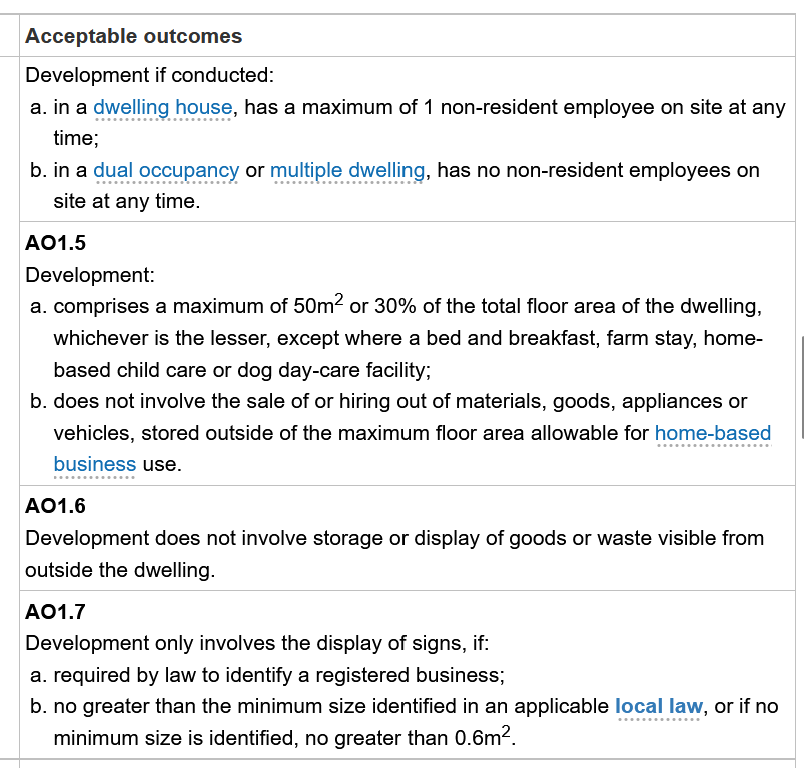
These rules matter not only for commercially-oriented small businesses, but for other non-profit, community-focused uses of residential properties (which council inspectors sometimes treat as businesses when it’s not clear how else they should be characterised).
Turnstyle was a great example of a non-profit, community-focused use of a backyard and undercroft space of a sharehouse on a residential street
Of course, there are hundreds – perhaps thousands – of home businesses and home-based community projects across Brisbane that technically violate council rules. Many non-compliant home businesses operate under the radar for years, but the uncertainty limits how widely they can advertise and how much the owners feel they can invest in their site.
If reforms are made in this space, existing regulations mustn’t be loosened so much that entire residential properties in suburbia are converted into commercial uses, as this could reduce housing supply and drive up property values. But if one of our goals is to support residents to walk shorter distances to access goods and services (rather than driving further away), opening up more opportunities for businesses and community activities within suburban neighbourhoods is surely worth exploring.
It’s hard to say with confidence how much suburbia could change if it became easier to legally operate restaurants, green grocers, shoe stores and yoga classes out of the garages and back sheds of suburban homes, because Brisbane has never proactively facilitated this. My guess is that in the wealthiest suburbs, not much would change, but in poorer outer-suburban areas (where the distances to existing shops and services are often longer, and people struggle more with high transport costs), I imagine we’d see plenty of entrepreneurs and community projects carving out interesting niches.
I wonder if the main reason Brisbane's never had a stronger push in this direction is that there are so many vested interests – commercial property investors and developers, mall operators, supermarket chains, fast food corporations etc. whose profits could suffer if there was suddenly a massive increase in the number of properties that could be used for recreational or commercial activities.
There are no major, well-connected lobby groups pushing for a rethink of home-based business rules. But that doesn’t mean we should ignore the opportunity.
I’m not proposing a comprehensive plan for South-East Queensland suburbia or claiming to have all the answers. But right now no-one really seems to have a concrete vision for what happens to our existing low-density suburbs – they just point to vague explanatory diagrams about 'missing middle' housing while continuing to waste taxpayer dollars on never-ending road-widening projects.
It feels good to share diagrams and artist impressions of well-designed, leafy, medium-density public housing projects, but only a very small proportion of existing suburban properties are likely to ever redevelop along those lines. Here in Brisbane, and indeed in most Australian cities and towns, we need more honest and realistic conversations about how we adapt suburbia, rather than pretending we can magically replace it altogether.

Thanks for reading! I make sure all my articles remain freely available to the public without paywalls, but if you value Brisbane-focussed commentary on urban planning and housing policy that cuts through the property industry spin, please consider supporting my writing by subscribing.

Member discussion