WTF? Non-birthing partners can't stay at the hospital with their newborn?

Recently I became a parent, which has been a really joyful time (and for me, a much slower pace of life than the previous few years). My partner and I have been fortunate to have stable housing and a lot of support from friends and family members. But it's still been quite a radicalising experience. Politically speaking, there's been heaps to unpack from my first months as a father.
In this 35-minute audio file, you can listen to a recent discussion recorded with my partner Anna and our cohousing conspirator Briohny from an episode of 4ZZZ's Radio Reversal. We talk about the systemic pressure towards hetero-normative nuclear family parenting, the joyful silliness of caring for a newborn (and some of the political implications of that), the inherent communism of parental support networks, and a bunch of other stuff.
You can listen to Radio Reversal on 4ZZZ 102.1FM on Thursday mornings at 9am, or find past episodes online via the 4ZZZ On Demand website.
I have lots of nice things to say about the public health system and all the doctors, nurses and midwives who looked after us throughout Anna's pregnancy and the birth, but there was one specific public hospital policy that we found really jarring.
I suppose I was a little naive, because prior to becoming a father I had no idea about this and hadn't given much thought to the hospital experience of new parents...
Unlike most private hospitals, in Queensland's public hospital system, non-birthing partners aren't allowed to stay overnight in the maternity ward. They are required to go home at 8pm, and can't return to visit their newborn child until 6:30am the next morning.
The same is apparently true at most public hospitals in all other Australian states (but not in the ACT).
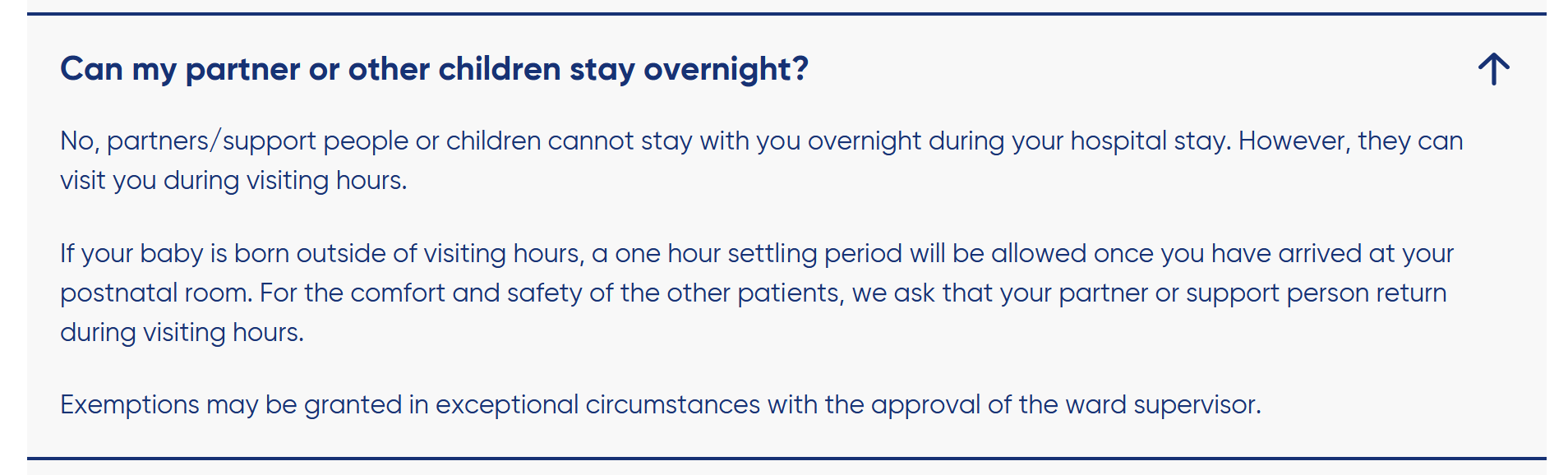
I was completely taken aback by this rule. After months and months waiting eagerly to meet my new son, the idea that I would be prevented from staying by his side on his first night out in the world hadn't even crossed my mind.
In the public wing of the Mater Hospital at South Brisbane (where my son was born), some maternity ward rooms are private with a private bathroom, and some are shared between two patients, with the beds separated by curtains.
Generally speaking, the public hospital system likes to discharge as soon as possible, rather than keeping people in overnight. Assuming no complications, in a lot of cases, the baby and birthing parent will be sent home within six to eight hours of birth.
So where families do stay on the ward for a night or two (or longer), it's often because the birthing parent is recovering from a caesarean birth and/or other complications.
Imagine a mum who has just given birth and is extremely drained from the experience. She's in an unfamiliar hospital environment where she doesn't know anyone, and staff are changing every shift – often with rushed and incomplete handovers.
She's recovering from a caesarean section – major surgery – and has been instructed that she should try to avoid lifting her baby for the first day or two while the wound is healing.
She might even be completely confined to her bed, with an IV drip or catheter still attached, and is learning to hold and breastfeed her baby for the first time.
Despite being extremely tired, she may well have to get up a couple times overnight to feed her newborn, and will find that while the ward staff are mostly very helpful, they're often too stretched to arrive immediately when she presses the call button to request help with going to the bathroom or soothing the baby.
In this context, sending home that new mum's partner/support person at 8pm is a recipe for extra, unnecessary stress.
The hospital hierarchy offers a couple of justifications for this policy that don't stack up to close scrutiny...
One explanation is that some new mothers might feel uncomfortable if there are men they don't know hanging out overnight in their shared maternity ward room (the words 'cultural needs' are thrown around a bit without much specificity). But this rule applies whether you're in a twin room with privacy curtains or a completely private room. And tellingly, it's equally applicable to lesbian couples – non-birthing mums also have to go home overnight.
If the hospital was purely concerned about having men present overnight in the maternity ward, they could allow a recovering woman's sister or mother or female friend to stay with her, but there are no exceptions to the 8pm lockout.
Any argument that women of some cultural backgrounds will feel more comfortable on a ward without men present needs to be weighed against the widespread cultural norm that a woman who just gave birth should not be left alone overnight in a strange place without any support from family members or friends.
Another purported justification is that people recovering from giving birth will get better rest if they're not distracted by their partner, and that it's also better for non-birthing parents to go home for a proper night's sleep and to 'get the house ready' for their baby. I don't buy this argument for a second. There's no research backing it up, and it's not a position that private hospitals take – even the maternity ward of the Mater Mothers Private Hospital, in the very same building as the public maternity wards, allows a partner or other support person to stay overnight.
I don't care if public hospitals don't have the resources to provide beds for guests. I'd rather bring my own blanket and pillow and sleep sitting upright in a chair in the corner than be separated from my partner and newborn son.
During our stay at the Mater, we spoke to several midwives and nurses who clearly disagreed with the hospital's policy that partners/support people can't stay overnight. In fact they disagreed so strongly that they looked the other way and actually allowed me to stay overnight with my partner (I slept on a long cushioned seat next to her bed that had clearly been designed and positioned to be used as a guest bed). I will be forever grateful to those nurses, and I hope they didn't get into too much trouble for bending the rules for us.
I'm guessing the real reason for the policy is that some men can be difficult to deal with, especially when they're tired and stressed after watching their partner go through the exhausting and dangerous process of giving birth.
It might also be the case that support people are often more assertive and effective advocates than someone who has just given birth – asking more questions, pushing for a higher standard of care etc. – which can be inconvenient for hospital adminstrators who are trying to stretch their limited overnight staffing resources.
And there have probably even been a few situations where a partner has nowhere else to live, and tries to crash on the hospital ward for as long as possible, even if the recovering mum doesn't really want him there.
But rather than finding more nuanced and compassionate ways to deal with those challenges, public hospitals have instituted a blanket rule that causes a lot of unnecessary grief and stress.
I've spoken to several friends who feel deeply indignant that they were kept apart from their newborn child on their first night in the world.
While the Mater does have a process where, in rare circumstances, partners can get an exemption from this rule, apparently only two or three exemptions are granted each year. I put a call through to the maternity ward of Royal Brisbane and Woman's Hospital (on Brisbane's inner-north-side) and was told that the rate of exemptions there is just as low.
The practice reinforces patriarchal divisions of care labour, signalling to new parents that it's solely a mother's responsibility to get up in the middle of the night to soothe her crying baby – dad isn't required.
Most midwives and nurses are compassionate and hard-working, but they can't be everywhere at once.
I heard one story of a new mum sobbing uncontrollably by herself in her room on the first night after a traumatic birth. At a time of heightened awareness and concern about post-partum depression, it's baffling that hospitals would push women into such isolation.
The irony is that while hospital administrators might argue that more overnight guests means more work for staff, in a lot of cases, if someone who has just given birth could have a support person staying in the ward with them, this would materially ease nurses' workloads. The policy means patients are more dependent on staff for help with simple tasks like changing a baby's nappy or getting up to use the loo.
Here's an anonymous quote from a new dad on the website CareOpinion about King Edward Memorial Hospital in Perth...
"KEMH has a visiting policy that doesn’t allow partners to stay overnight with their new baby/babies on the ward with the mum. My wife delivered twins via c-section recently close to midnight. They were initially brought to special care nursery but were able to be on the ward with mum after 12 hours which was wonderful. Unfortunately, the hospital won’t let me, husband and father of newborn twins to stay overnight to help care for the twins and my wife which means my wife is trying to recover from a c-section and take care of two new babies and try to express breast milk all on her own overnight. I believe the nurses are so busy that every time my wife calls the nurse it takes them forever to get to her so the babies are crying, my wife needs assistance to get out of bed as she is still bleeding from surgery and she can’t pump every 3 hours as they’ve recommended.
I believe the hospital needs to allow husbands/fathers or at least 1 support person to stay overnight to help as I feel it’s so difficult for a new mum, the new babies and strain the whole family when mum is struggling. I believe it has a huge impact on mental health and really needs to change now. In my opinion, it’s archaic considering society is now encouraging dads to take a more active role in parenting."
Evidently I'm not the only person who doesn't like the rule.
It seems the one place in Australia where this rule doesn't apply is the ACT. In Canberra, it's common for a support person to stay overnight in the maternity ward after birth, and the national capital's public hospital system readily accommodates this.
I can't say I'm surprised that there are different rules for Canberrans.
I wonder if this difference reflects the fact that in the rest of Australia, middle-class and upper-class families are more likely to use private hospitals, whereas in Canberra, more of those kinds of privileged people are going through the public system, and rightly demand that a support person be allowed to stay overnight.
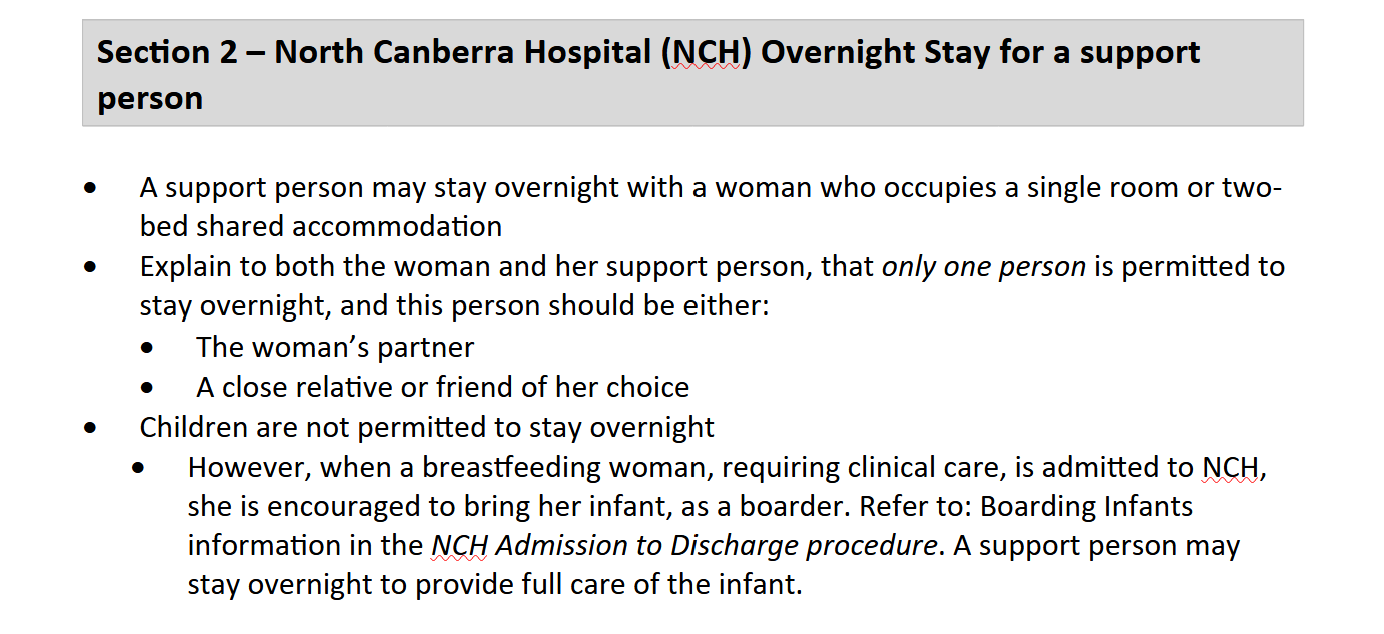
I haven't researched in detail how things work in other countries. The general trend seems to be that those with more money and privilege get private rooms where partners can stay overnight, while the working classes are made to tolerate forced separation of non-birthing partners from their newborn children.
I can't imagine any of the LNP politicians who have the power to change this at a Queensland government policy level caring enough about it to make waves – they don't even want to improve hospital staffing ratios or workers' conditions.
It's just one shitty little thing in a long list of issues with the public health system. But it would also be so easy to rectify.

For more rants about Queensland politics, please consider subscribing to my newsletter. I aim to send out one email every month or so with a roundup of important upcoming events and recent articles I've written...





Member discussion