Thousands of Brissie homes have been converted to Airbnbs – Why did the council backflip on regulating them?
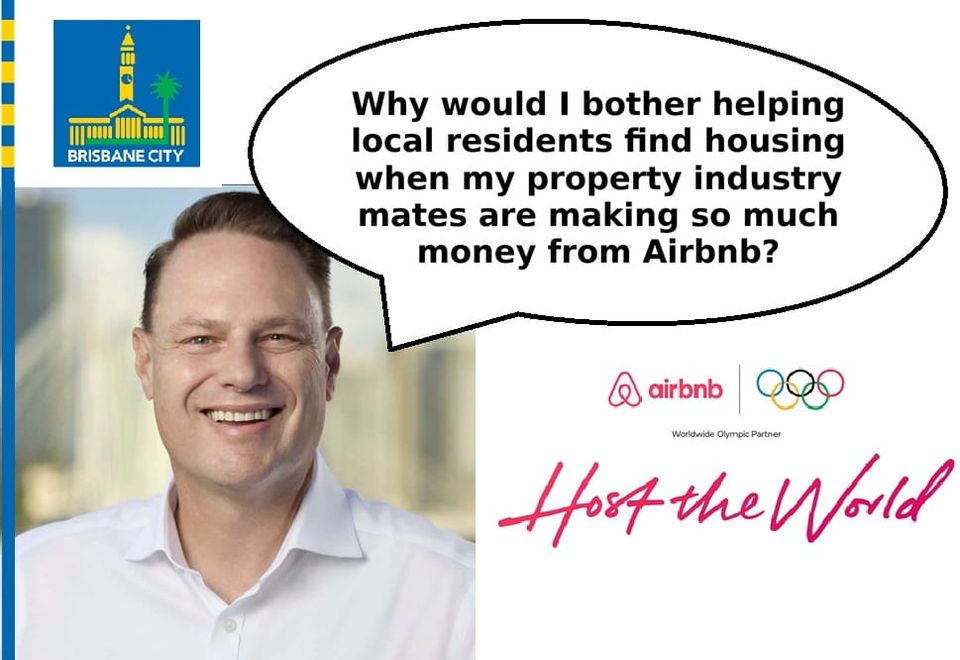
One of the stranger sideshows of this year’s federal budget was Lord Mayor Adrian Schrinner announcing that Brisbane City Council is abandoning very minor reforms to regulate short-stay rentals ('SSRs') listed on platforms like Airbnb, and trying to blame it on Labor’s proposed changes to negative gearing and capital gains tax discounts.
Given the rising number of Brisbane homes being converted into SSRs, the mayor’s questionable justification for his backflip didn’t attract the level of media scrutiny it deserved, particularly given that Airbnb is a top-tier Olympics sponsor. The housing crisis is even worse than it was in June 2022 when Schrinner first conceded he was concerned about investors switching to short-stay rentals, saying "we want them to put those properties back into the rental market for long-term use."
Dozens of councils around Australia – from larger cities and towns to smaller coastal villages – have been introducing higher fees and tighter regulations for investment properties that are used as entire-home SSRs (as distinct from residential homes that are only temporarily listed on Airbnb when the residents leave on holidays).
Byron Shire Council’s reasonably strict rules prevent investors renting out any property via platforms like Airbnb for more than 60 days per year (except in two specific beachside sub-precincts within Byron Bay and Brunswick Heads), while Sydney City Council is investigating banning Airbnbs altogether.
Noosa Council (150km north of Brisbane) has one of Queensland’s tightest regimes, charging both higher rates (100% higher than residential rental) and annual permit fees. The extra council fees and rates to operate an Airbnb rather than a long-term rental average around $3000 per year (depending on the property’s value). Crucially, Noosa doesn’t automatically approve or renew short-stay letting permits, and seems genuinely concerned about the amenity impacts on residential neighbours.
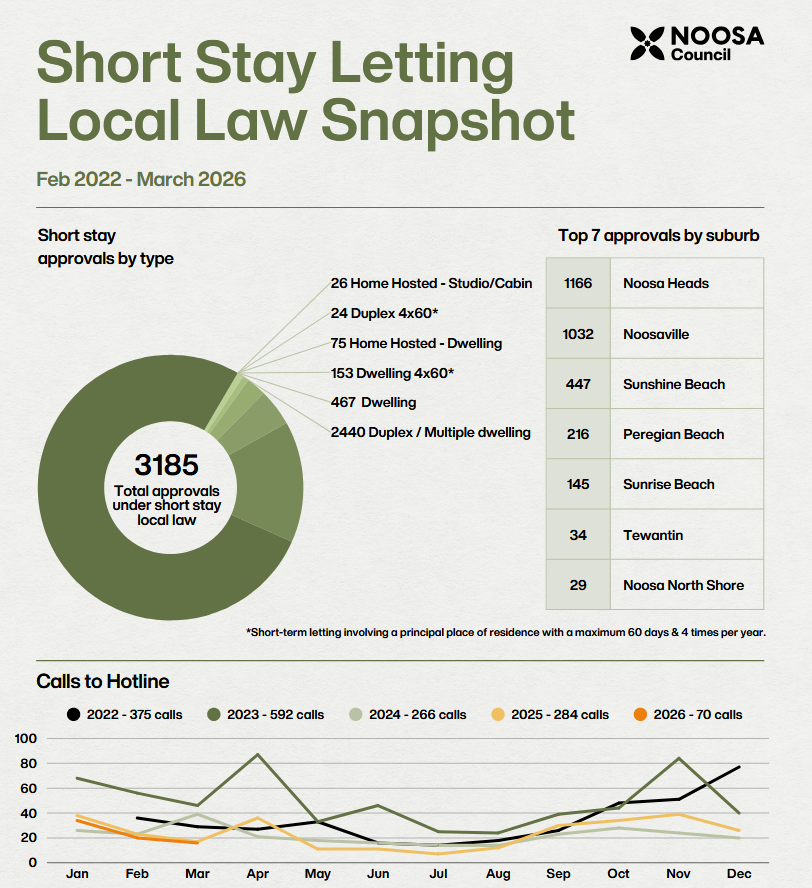
The backlash and crackdown has been far stronger in many other parts of the world. New York has effectively banned whole-of-property short-stay rentals, as have numerous European and Asian jurisdictions.
When other cities are taking both the housing market and neighbourhood amenity impacts of short-stay rentals more seriously, Brisbane’s sluggish response highlights that the LNP remain resistant to any policy change that could put downward pressure on property values. Before the 2024 council election, they showed promising signs of a shift on this front, but that’s all changed again as the Olympics approaches.
Backing away from doing the bare minimum
In 2022, under pressure from the Greens, and amid rising complaints from inner-city apartment residents about their buildings feeling like party hotels, the LNP-led council introduced a new ratings category – Transitory Accommodation – which charged 50% higher rates for residential houses and apartments rented out on platforms like Airbnb and Stayz on an ongoing basis. Reports suggested this only represented an average rates increase of around $600 per year – hardly enough to deter hosts who charge hundreds of dollars per night. But treating these properties differently from residential homes was at least a small positive step.
In 2023, BCC quietly added another rates category – Owner Occupied with Guest Accommodation (see my extra comment below this article regarding the vague definition of this ratings category) – to cover situations where an owner lives on-site but rents part of their property (like a granny flat or guest wing) to short-stay guests. At the time, this rates category was a nominal 15% higher than the standard owner-occupier ratings category.
The council has been gradually ratcheting up both these categories without drawing attention to it (in the 2026/27 rates resolution, rates for Transitory Accommodation properties are 70% higher than rates for residential rentals, and Owner Occupied with Guest Accommodation properties pay 20% higher rates than other owner-occupied homes.
BCC also established a ‘Short Stay Accommodation Taskforce’ to investigate the impact of platforms like Airbnb and Stayz on housing supply and neighbour amenity. Unsurprisingly, the taskforce's June 2024 report was heavily shaped by whose voices it did and didn't listen to. The list of 36 stakeholders (p. 90 of the report) is dominated by property industry lobby groups and private corporations who directly profit from SSRs and/or have a general interest in residential property values continuing to rise.
In 2024 the taskforce recommended a permit system rather than a ban or punitively high rates, and the administration drafted a new local law to create a registration framework for short-stay rentals. This included requiring owners to hold public liability insurance and provide BCC a 24/7 phone number for property-related complaints. While these don’t seem like particularly onerous requirements, it’s conceivable that the extra hassle might have deterred some investors from switching to SSR.
The council also said it would crack down on SSRs in residential areas where the zoning doesn’t permit short-term rental accommodation (0perating whole-property Airbnbs in such areas is technically already illegal as it violates the council’s city plan, but the LNP administration hasn’t put much effort towards enforcing existing rules). In December 2025, the council was still publicly celebrating its plan for permits and stronger investigation efforts.
Public submissions on the draft local law closed on 16 February 2026, and the new rules were supposed to take effect from 1 July 2026. But on 12 May, the mayor made a short speech in the council chamber announcing the council had changed its mind, saying of Albanese’s budget, “We know that what is being discussed in recent days and weeks about changes to federal taxation relating to housing investment has certainly created a high level of uncertainty in the market… we know that in this kind of environment, creating more regulation, more red tape and making housing investment even harder is not something we should be doing in this current situation of uncertainty.”
Running disingenuous arguments about not wanting to discourage housing investment with ‘red tape’ is playbook LNP. But undertaking the long, resource-intensive process of drafting a new local law (including undertaking public consultation) only to abandon the reforms at the eleventh hour is very unusual behaviour for Brisbane City Council. I couldn’t find another example like this in at least the past 15 years.
A few commentators have suggested that because the number of Brisbane properties leased as short-stay rentals represents a small proportion of total dwellings in the city, the spread of Airbnb isn't a major concern meriting further council action. But that narrative doesn't stack up to close scrutiny.
How big is the problem?
Pinning down an accurate estimate of how many Brisbane homes have been converted into short-stay rentals is a little tricky.
Airbnb is the biggest platform operating in Brisbane, followed by Stayz/Vrbo and Booking.com. But there are also smaller operators who might only manage 10 or 20 properties, often targeting specific niche markets. They advertise on their own websites but sometimes also list the same property on multiple larger platforms (this is recommended practice for most investors). None of the larger sites publicly disclose how many unique property listings they have, and we don't even know exactly how Airbnb's market share in Brisbane compares to its competitors.
But if we can at least count Airbnb listings, that gives us a conservative, lower-end estimate for the total number of short-stay rentals across the city.
Thankfully, the non-profit service Inside Airbnb routinely scrapes Airbnb's listings to produce relatively accurate estimates and map trends over time.
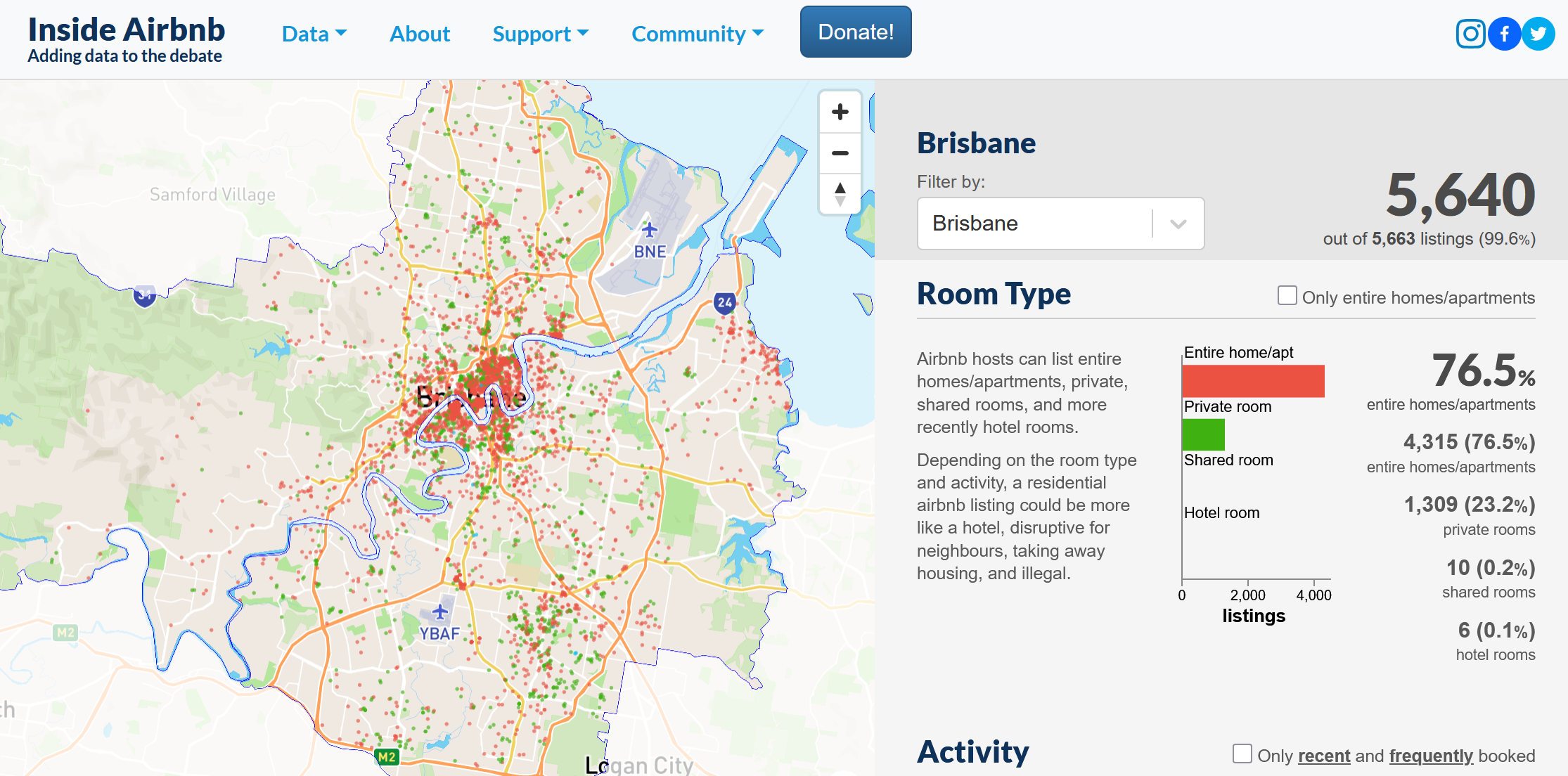
If you narrow the Inside Airbnb search to 'Only entire homes/apartments' and 'Only recent and frequently booked' you can exclude properties where residents are just renting out a spare room, or only renting out their home for a couple weeks a year when they're out of town.
In late June 2026, that returned a figure of 2280 self-contained dwellings that appear to be permanently used as Airbnbs. As of 23 July, the number has already climbed to 2439. Add in a couple hundred for each of the other major platforms and we're conservatively looking at over 3000 dwellings which could be housing locals but are instead used as short-stay rentals in the Brisbane local government area (with more in neighbouring council regions like Logan and the Redlands).
Brisbane City Council's own data provided via council meetings seems to support this. In the 2025/26 financial year, the council applied the 'Transitory Accommodation' rates category to 2258 properties (this number has grown steadily each financial year since the category was introduced). So the council obviously hasn't identified all the properties in Brissie that are being used as short-stay rentals, but their official figure is in a similar ballpark.

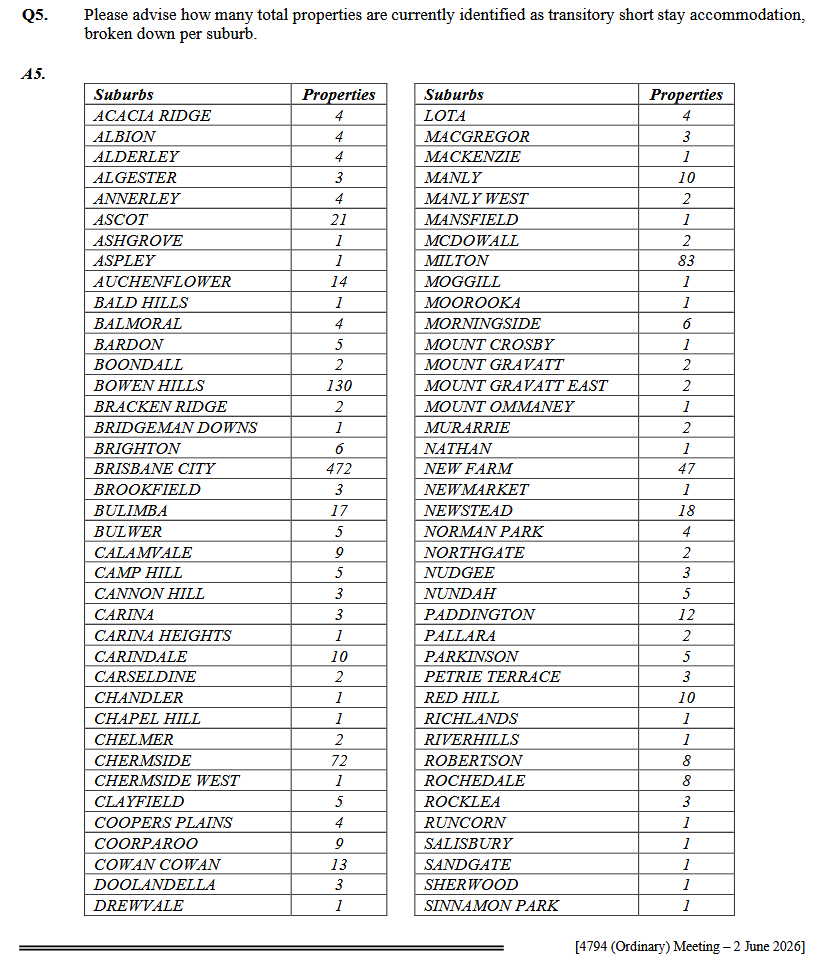
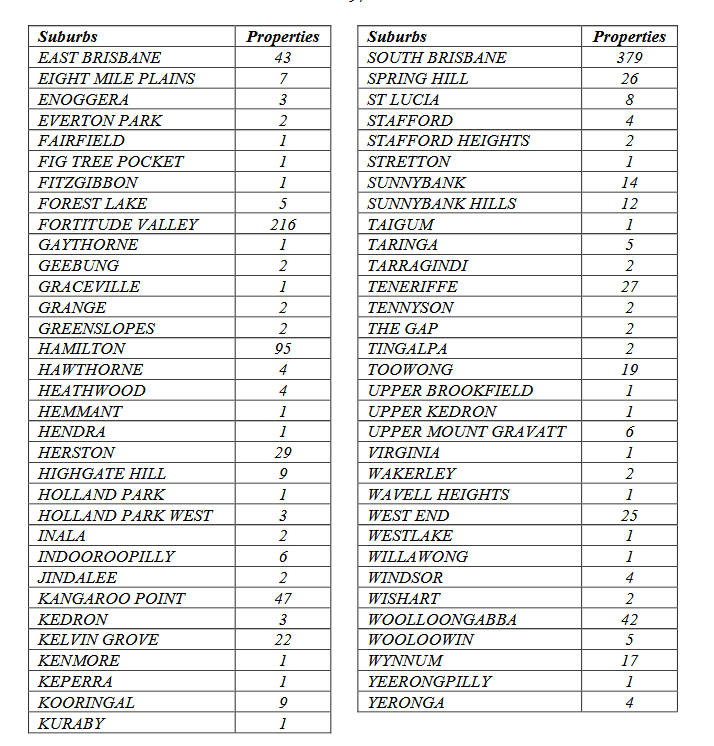
Data released by Brisbane City Council in June 2026 reinforces the picture from Inside Airbnb - the vast majority of short-stay rental investment properties are concentrated in Brisbane's inner-ring, in areas with larger numbers of units
Apart from the obvious factors driving tourist demand closer to the city centre and public transport hubs, a key reason most Brisbane SSRs are apartments rather than free-standing homes is that under the council's local laws and city plan codes, short-stay rental generally isn't a permitted property use in areas zoned low-density residential.
New apartment projects usually (but not always) include short-stay rental uses as part of their council development applications, so development approval for SSR automatically applies to all units in the new tower block. And in parts of the city zoned mixed-use, district centre etc., even free-standing houses can legally be used for SSR. But most suburban Brisbane homes in residential areas can't legally be rented out on platforms like Airbnb on an ongoing basis.
That doesn't entirely stop owners from doing it, but they have to operate under the council's radar (if you suspect a home in a low-density residential area is being used as a short-stay rental, you can report it to the council – they usually require at least 3 resident complaints to launch a proper investigation). This perhaps helps explain why InsideAirbnb's count of the number of self-contained Airbnbs in a suburb like West End (61 properties), where the zoning of most blocks does not permit SSR, is so much higher than Brisbane City Council's total West End count of all Transitory Accommodation properties on all platforms (25 properties).
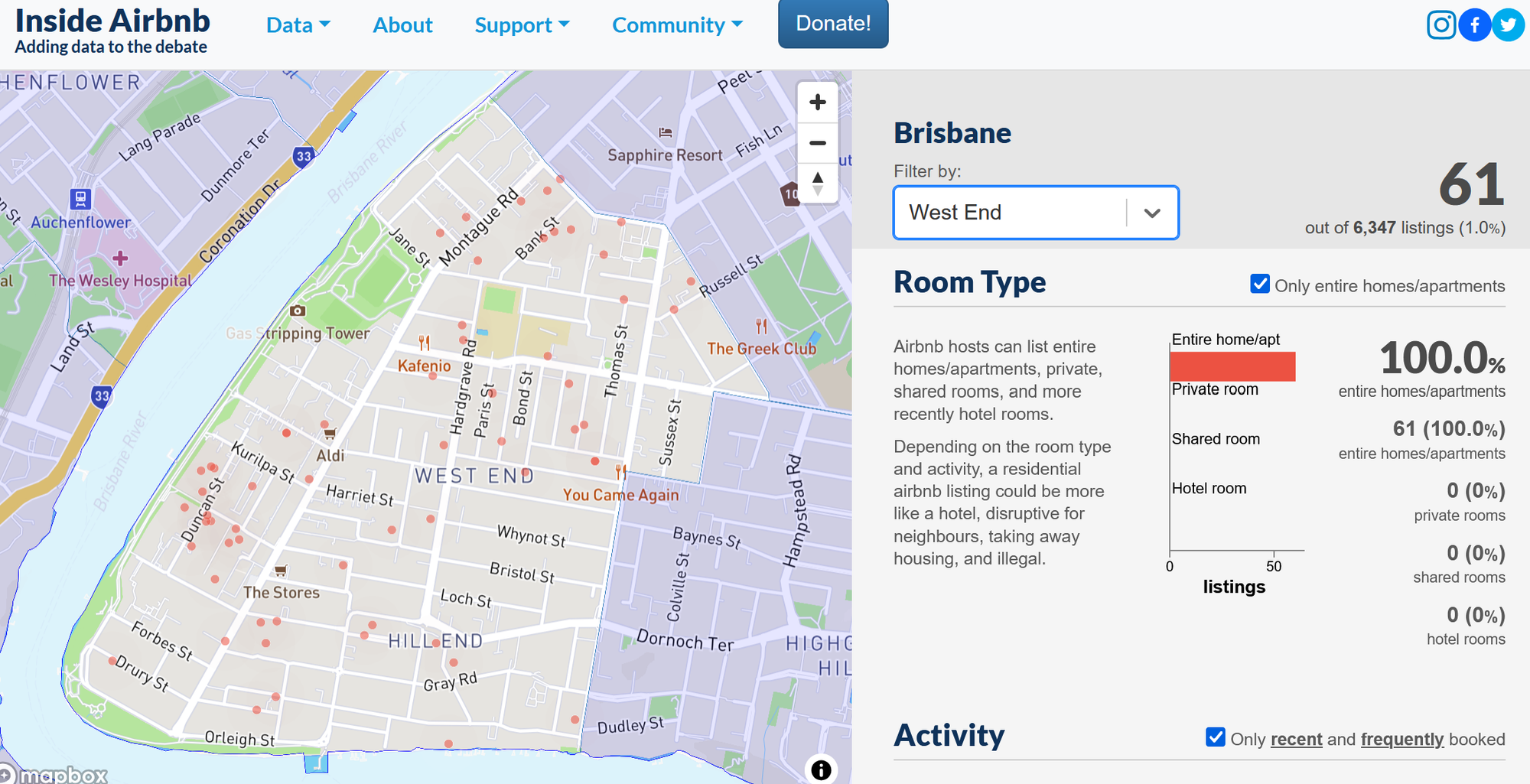
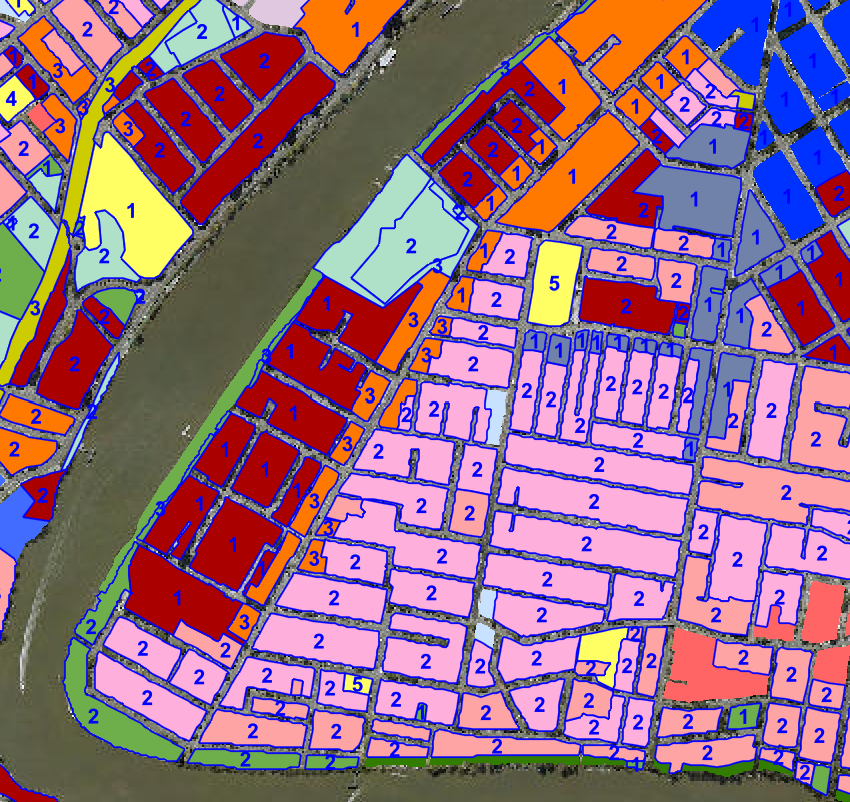
First image: InsideAirbnb snapshot of West End; second image: BCC's zoning map of West End - short-stay rental generally isn't permitted for any property within the light pink residential-zoned areas unless an owner has lodged a specific development application for their property (also requires compliance with higher fire safety standards etc.)
In a city of around 550 000 residential dwellings, Brisbane's 3000+ short-stay rentals clearly aren't the main driver of obscenely high rents and property prices. But once you start comparing the different datasets (including rental vacancy rates, census data etc.), you realise SSRs are a bigger factor than most policymakers seem willing to acknowledge.
Rental vacancy rates have been persistently tight in Brissie for years now. At any given time, only a couple thousand homes are advertised for rent in the Brisbane local government area. And short-stay rentals are concentrated in high-demand inner-city suburbs with good public transport. These are the neighbourhoods with the highest numbers of rental properties, whose rental markets shape the baseline asking rents for the whole city.
In the rapidly-growing suburb of South Brisbane, for example, roughly 1 in 10 investment properties are permanent SSRs. The same is true in Brisbane's CBD. In Bowen Hills it's around 1 in 15.
A simplistic analysis that compares the estimated number of short-stay rentals to the total number of dwellings across Brisbane might underestimate and dismiss the impact of SSRs on rental affordability. But when such high proportions of rental stock in the inner-city are converted to SSRs, this tightens demand and drives up asking rents in market-leading suburbs like South Brisbane. And when newer 2-bedroom units in South Brisbane are routinely renting for upwards of $1000 per week, it would be naive to argue that isn't also impacting how much rent landlords in Greenslopes or Indooroopilly can get away with charging.
The ability to convert homes into hotel rooms also boosts investor confidence. Prospective landlords know that if the bottom drops out of the long-term rental market, or the tenant they're price-gouging moves out at short notice and they're suddenly left with a vacant property, they can always switch to Airbnb. Even if only a relatively small number of investors actually do this, knowing it's always an option makes landlords in general more confident about squeezing their long-term tenants for higher rents.
On the other hand, if hundreds of extra long-term rentals suddenly came onto the market due to tighter restrictions on short-stay rentals, that would have a significant and lasting impact on baseline advertised rents across the city (even if that extra supply were absorbed reasonably quickly).
I suspect the LNP knew that when they backed away from introducing regulations here in Brisbane. A sudden, high-profile crackdown on Airbnbs could have depressed the rental market, pissing off all their property industry mates.
The politics of how homes are used
At this point it's worth mentioning that multiple LNP city councillors are themselves property investors with direct financial interests in property values and rents continuing to rise. At least one councillor, Krista Adams, has disclosed ownership of investment properties that she rents on Airbnb (although hers aren't in Brisbane itself).
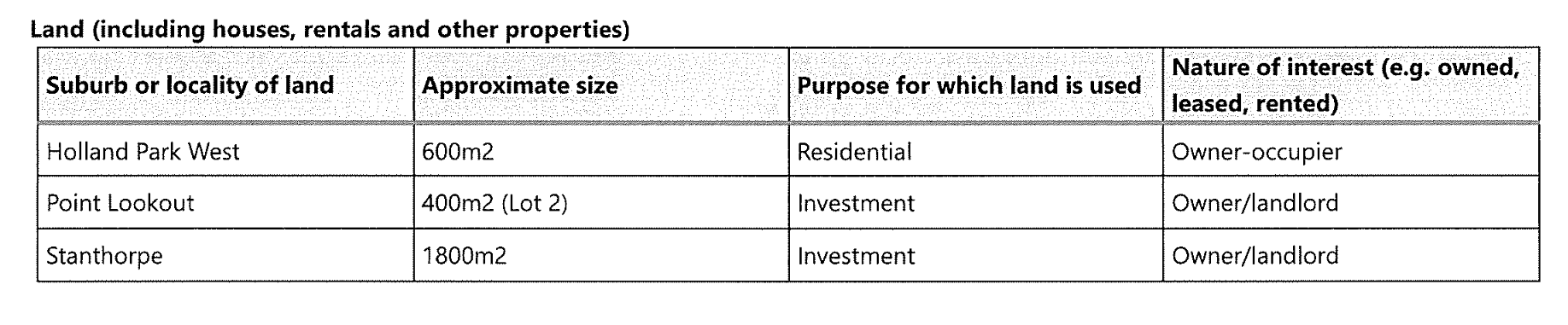

Under current rules, owning investment properties doesn't prevent politicians from voting on council laws and policies that are likely to impact the revenue from or value of their investment properties. I think that's absurd – these councillors clearly have a conflict of interest on this issue.
But this situation reflects Australia's cultural normalisation of treating housing as a commodity.
Putting aside debates about exactly how many Brisbane homes have been converted to Airbnb, and what effect that change in rental supply has on affordability, the prevalence of short-stay rental platforms has a deeper negative cultural impact on how we view real estate.
In Brisbane, the majority of buildings were specifically zoned, designed and approved as residential homes. Rightly or wrongly, across most of the city, the council's regulatory framework recognises that dwellings should be used primarily as housing for local residents even if houses could hypothetically be renovated and converted to other more profitable commercial uses. While legitimate home businesses are permitted, the idea of repurposing entire homes for other activities that make more money is generally discouraged.
Airbnb and other SSR platforms introduce a slippage into this landscape. If homes can easily be converted into hotels, this repositions housing as a commercial asset that should be used in whatever way makes the most money. In fact, where real estate is owned by companies or super funds, directors may even have an obligation to switch those properties to short-stay rentals if that will make more money for their investors.
"It's my property – I should be able to do whatever I want with it!" is an increasingly common refrain among investors, even though it was never actually true. All manner of rules limit what people can and can't do with their properties, particularly in cities where space is in short supply. But by chipping away at the idea that housing should only be used as housing, short-stay rental platforms pour petrol on the fire, helping reconceptualise our residential neighbourhoods as mere assets waiting to be carved up for profit.
So even if Brisbane was only home to a few hundred Airbnbs, I'd still argue for a ban on whole-of-dwelling short-stay rental conversions. But right now, there are at least 3000, and the number is still growing.
What's ahead of us?
Since covid travel restrictions ended, the number of Brisbane dwellings permanently converted to short-stay rentals seemed to have been steadily increasing by about 200 per year, but the sudden increase after the mayor announced he's backing away from regulation suggests the conversion rate is climbing sharply. Without tighter regulation or an all-out ban (as Sydney is exploring), it seems likely that rate could increase significantly in the years leading up to the Olympics.
But anticipating how much demand there'll be for short-stay accommodation – whether actual hotel rooms or converted dwellings listed on platforms like Airbnb – is incredibly difficult. The loudest voices in the conversation have their own agendas and biases, with so many variables affecting a) tourist demand, and b) what kind of accommodation offerings emerge to meet that demand.
There's lots of research examining the tourism impacts for previous mega-events. Some papers find that impacts to net tourism numbers are pretty small. Other research suggests the biggest host city tourism boosts come in the years immediately after the games. But looking too closely at the experiences of very different cities in very different global economic contexts mostly just muddies the waters; both the domestic and international tourism industries – and indeed the broader world order – will likely have changed so much by 2032 that past experience hardly seems worth referring to.
Even research commissioned by the Queensland Government concedes they don't really know how many additional tourists the games will attract. The 2021 KPMG report (notorious because of its questionable, heroic assumptions about the economic benefits of hosting) admitted "Findings in the literature are mixed about the size of the estimated tourism legacy benefits and the ability of major events to induce international tourism."
Will international tourists still be willing to travel long distances to a mid-tier city like Brisbane despite worsening global warming and geo-political upheaval? Will Olympics-related tourism deter and displace the tourists who would've otherwise visited South-East QLD (as experienced by the 2018 Gold Coast Commonwealth Games and by several previous Olympic hosts)? How many domestic tourists from other parts of Australia will travel to Brissie for the games?
No-one knows for sure.
And anyone who pretends they can accurately model this stuff is bullshitting you.
We do know the government plans to adjust school holiday calendars for 2032 to align with the August games period. So I wouldn't be surprised if a decent chunk of Brisbane's population decides to travel interstate or overseas during that time, as occurred during the 2014 G20.
If that happens, a lot of existing owner-occupier homes could temporarily be used as short-stay accommodation to offset Brisbane's alleged hotel shortage, without the need for an increase in permanent SSRs (I say 'alleged' because the Property Council of Australia – the group leading calls for more hotel construction – routinely uses whatever excuse it can come up with to argue for lower property taxes and less regulation in pursuit of its goal to keep real estate prices growing at absurdly high rates forever).
But even if we don't know exactly how many tourists the Olympics itself will attract, we know that if the LNP succeeds in their more general goal of dramatically expanding South-East Queensland's tourism industry over the next two decades, many more dwellings will be converted into SSRs.
International experience suggests that once tourism becomes a major part of a city's economy, the transformation of inner-city and beachside neighbourhoods into short-stay precincts can happen quickly, with abrupt, difficult-to-predict growth in SSRs as neighbourhoods reach tipping points. When 1 in 5 homes in your neighbourhood are Airbnbs, maybe you'll still feel like you live in a genuine community. But once 1 in 4 or 1 in 3 become tourist accommodation, the loss of community connection might prompt remaining long-termers to move out too, accelerating the transition.
BCC's long-foreshadowed crackdown on Airbnbs may in fact have helped stem the tide. Now that's been shelved, property management companies are reminding investors how easy and profitable it is to run an SSR in Brissie.
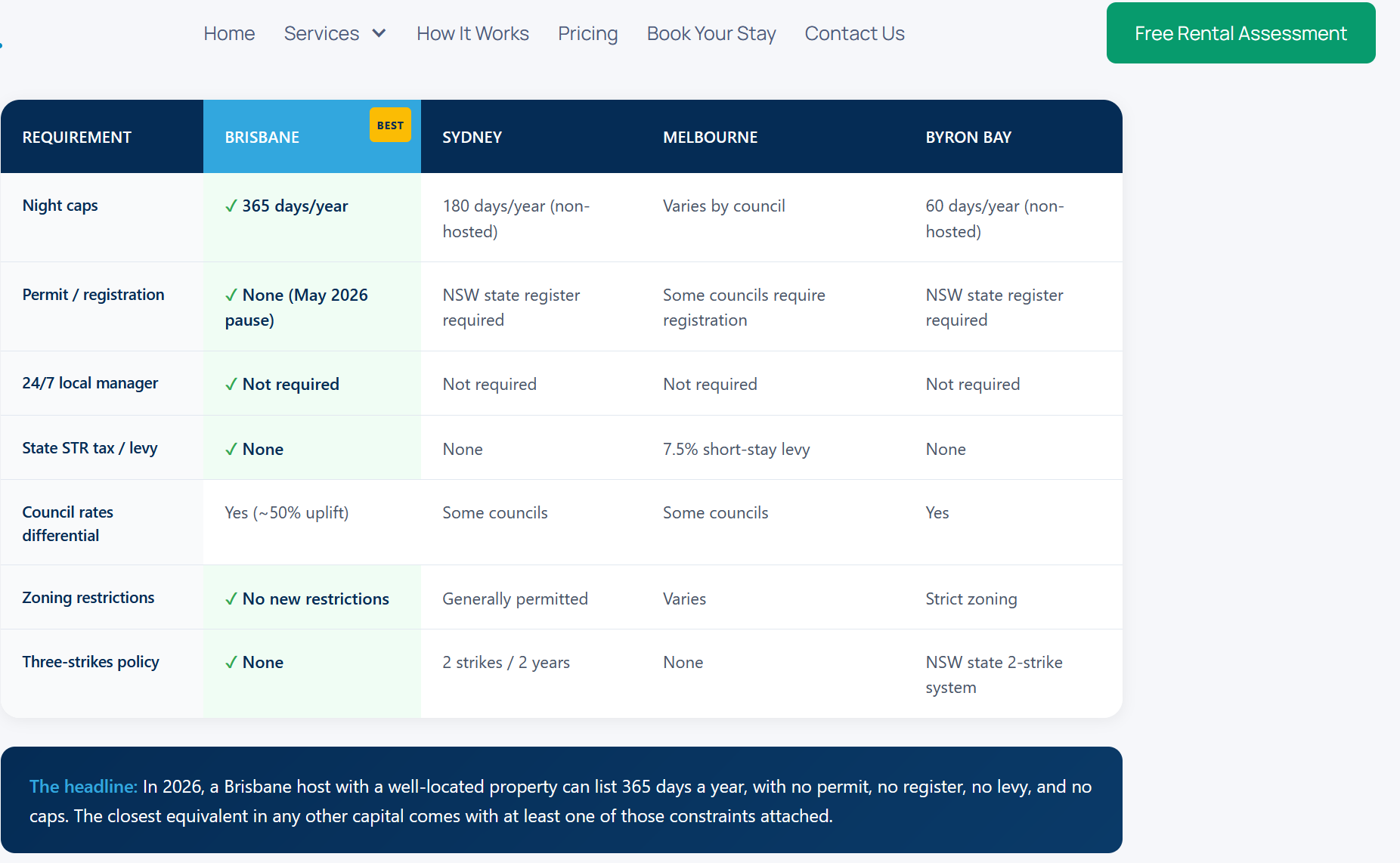
Crucially, Inside Airbnb highlights that Brisbane now has dozens of hosts listing multiple properties. Some of these are real estate agencies or property management companies like Bedspoke, which specialise in short-term rentals, while others are freewheeling individuals who take out multiple long-term residential leases on well-located properties, then rent them out as short-stay rentals – a lucrative hussle that requires no up-front investment beyond your standard rental bond.
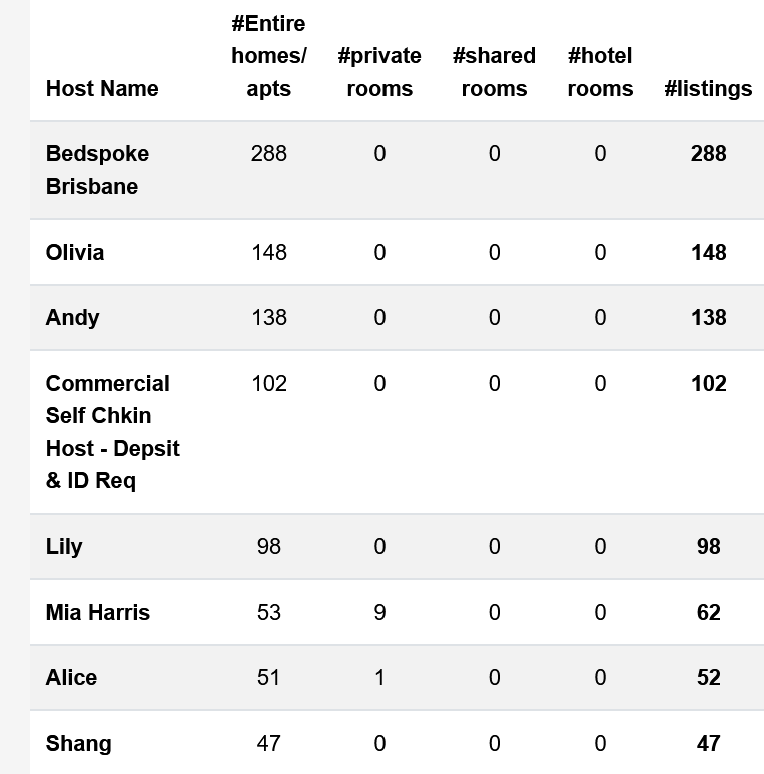
The rising number of operators managing SSRs that they don't actually own underscores how much of a problem this could become for Brisbane's inner-city housing market. When Brisbane renters line up to inspect an apartment in South Brisbane or Fortitude Valley, they're no longer only competing against other prospective tenants who want to live in those properties, they're also competing with would-be hotel room operators who can afford to pay much more to rent the same property, because they'll be sub-leasing it for hundreds of dollars per night (the LNP's permit scheme wouldn't have addressed this growing issue anyway).
But why the backflip?
None of this gets us much closer to explaining exactly why the council went from actively promoting its long-awaited permit system in December 2025, to backing away from it six months later. The council's vague, feeble argument that it's because some small, undefined proportion of Airbnbs are sometimes used as domestic violence crisis accommodation or by flood victims awaiting insurance payouts doesn't stack up to close scrutiny.
After the public submissions period closed, the council would have reached out to the state government to confirm it had no objections to the local law (which can't take effect without Queensland government support). So it's possible that even though BCC wanted to proceed with the new scheme, Schrinner's state LNP colleagues overruled him.
I still think it's possible the International Olympics Committee applied direct pressure on the Queensland government given that they're hoping to convince Airbnb to extend its global sponsorship of the Olympics beyond 2028. But if there is a digital trail, even a Freedom of Information request would likely run up against 'commercial in confidence' redactions.
Anyone – especially journalists – who gets a chance to put questions to Lord Schrinner should be asking him directly about this. What was the real reason BCC backed away from its long-awaited new regulatory framework? Did the IOC make a direct request?
And now that Brisbane has signalled it won't regulate SSRs (thus enticing more property investors to switch), how fast would the growth rate have to get before BCC re-evaluates its position?
The proportion of SSRs in Brisbane isn't yet as high or concerning as in many larger cities that attract bigger tourist numbers. But the numbers are growing faster than they were a year or two ago, particularly in the inner-city neighbourhoods that most heavily shape asking rents across Greater Brisbane.
The smart move would be to ban or at least heavily restrict them now, before the Olympics pressure for more short-term accommodation really kicks in and existing tenants are displaced en masse. Every additional home that's converted into a short-stay rental effectively represents another local family that will struggle to find stable housing. But I don't see the LNP turning their recent 180-reversal into a full 360 without significant public pressure.

To support more in-depth local political analysis like this, please consider signing up for a paid subscription.
Oh and to the full-time journalists and policymakers who I know are reading my articles to save time on your own research work, maybe consider making a one-off contribution of a couple bucks to share the love around...
Member discussion