Colonialism by any other name... The nationalist limits of 'tax the 1%'

"Make billionaires and big corporations pay their fair share of tax!" It's a key element of many left populist political platforms around the world.
It's wrong for some people to skip meals or sleep on park benches while others hoard multiple mansions or buy up entire tropical islands.
It's right to redirect wealth away from the richest 1% towards the other 99%.
Progressive political parties often suggest using this redistributed wealth to fund everything from free healthcare and education to high-frequency buses to renewable energy transitions to thriving arts and culture sectors. Their costings and policy commitments inevitably focus on providing a good life for citizens of that nation, in hope of building a big enough political coalition that will support a redistributive social democratic vision.
I'm a strong advocate of increased corporate taxation as an interim step towards a fairer world. Company shareholders have no right to profits that are extracted by exploiting workers and price-gouging customers (ideally billionaires and for-profit corporations shouldn't exist at all).
But are we thinking deeply enough about who should and shouldn't get a share of the revenue from taxing billionaires' wealth or corporations' profits?
When the Australian Greens say it's time to "take back your wealth," whose wealth was it originally?
And when we say taxing the 1% means we can afford to give everyone a better life, who do we mean by 'everyone'?
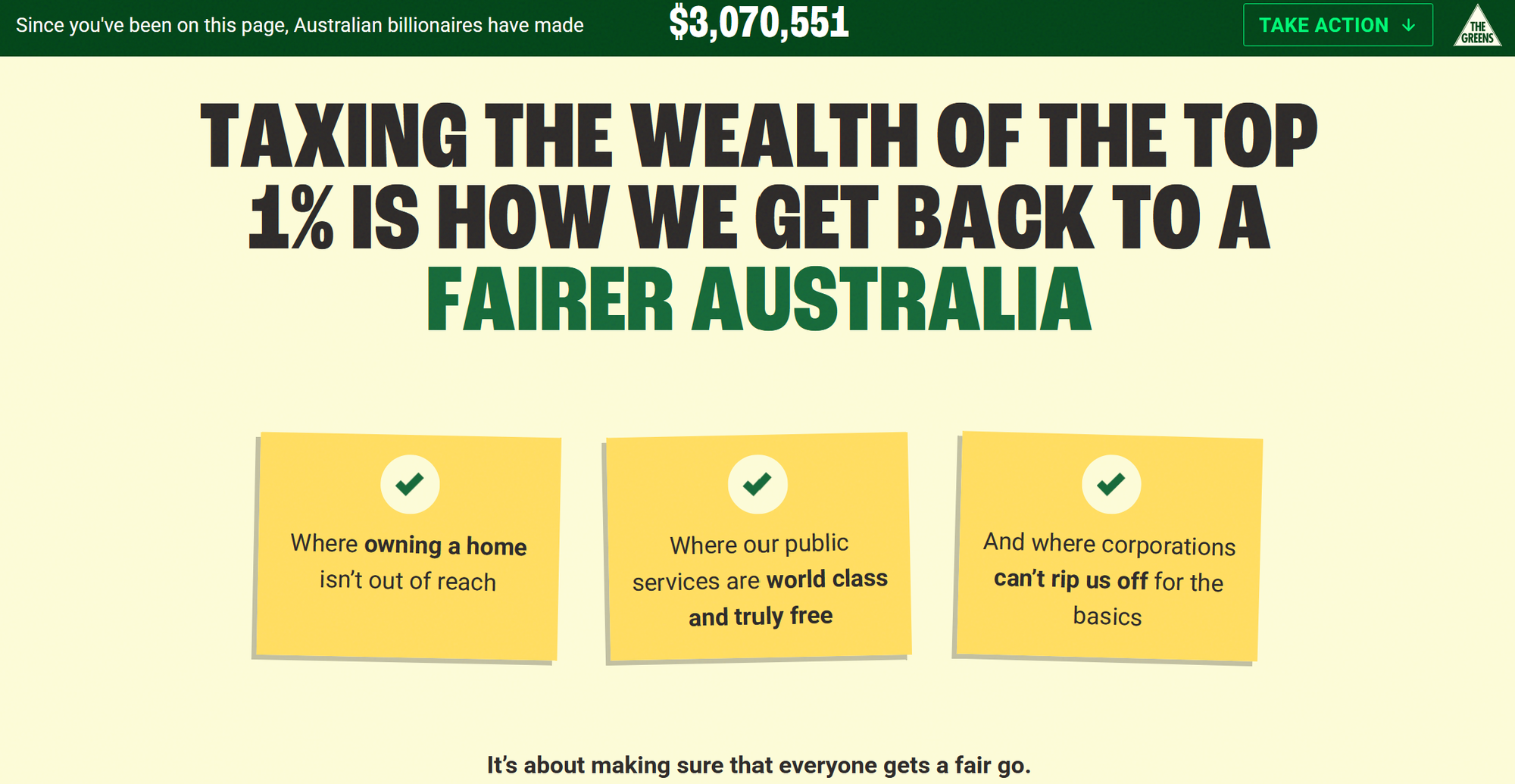
I've previously highlighted that 'progressive' proposals to tax Australian mining companies that extract resources from First Nations land are arguably reinforcing settler-colonialism rather than challenging it. Australia's mineral and fossil fuel resources rightly belong to Aboriginal people, not to the Australian government.
 Jonathan Sriranganathan
While companies in other industries might not necessarily be stealing mineral wealth from Indigenous people of this continent, the wealth is being extracted from somewhere.
Many Australian companies and individual billionaires make their money through selling goods and services produced in other parts of the world.
Resources – fossil fuels, minerals, timber, cotton etc. – are extracted in Asian, African and South American countries with weak environmental protections and workers' rights. Indigenous land-owners aren't compensated fairly, nor is anyone else who's impacted by the environmental harms at the point of production or along the international freight routes.
Perhaps those resources are also refined or manufactured into exportable commodities by workers who are paid criminally low wages, keeping them trapped in cycles of debt and poverty. The products are then transported to western markets by a global shipping industry that systematically exploits maritime workers from poor countries.
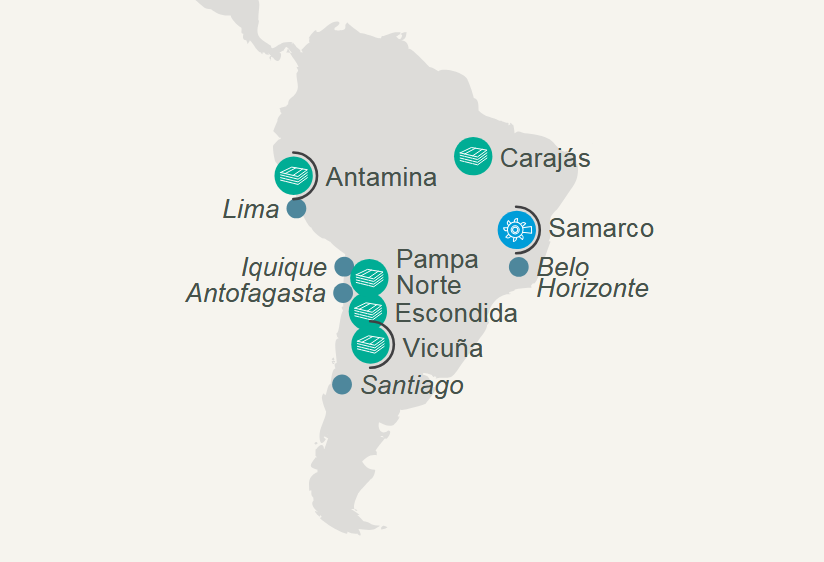
In many cases, Global North governments and companies support and even directly pressure Global South governments to use repressive, authoritarian violence to keep those exploitable populations where they are, while dispossessing them of their land and foreclosing other ways to make a living. They even weaponise free trade agreements and IMF structural adjustment programs to maintain weak labour laws, environmental protections and domestic tax obligations.
Nationalising such companies wouldn't necessarily fix this particular problem; then you'd just have government-owned businesses ripping off foreign workers.
It's hard to say exactly what proportion of Australian company profits we're talking about here, because comprehensive research into supply chains, profit margins and where that surplus value ultimately comes from isn't readily available. But I do know that the vast majority of smartphones, sofas, t-shirts and toiletries in Aussie homes weren't made in Australia. At least the bulk of our food is grown domestically. But a lot of the fertiliser for Australian farms is imported, and so is the fuel that runs the tractors and trucks.
The picture of transnational exploitation becomes even messier when you also consider how many Australian companies are now reliant on overseas call centres and outsourced IT work. Or the hundreds of thousands of skilled migrant workers who've come to Australia as adults but were raised and educated at significant expense by their countries of origin.
When we propose taxing billionaires and big corporations, we must at least remember that some proportion of that wealth – possibly a lot of it – has been extracted not from Australian workers or the local environment, but from other parts of the world.
Yet progressive think tanks and political parties who advocate funding social services and infrastructure by making the mega-rich 'pay their fair share,' never seem to talk about redistributing that taxation revenue internationally.
Who benefits?
Australia is enmeshed in, and benefits from, an unjust global economic system. Call it imperialism or neo-colonialism or whatever you wish. The point is that if it was wrong for European powers to forcibly extract wealth from their colonies to enrich imperial metropoles, we should also be sceptical of purportedly left-wing corporate tax proposals that have a similar (though not identical) effect.
Is it fair that surplus value extracted via Papua New Guinean gold mines or Bangladeshi garment factories is taxed in Australia to fund turn-up-and-go public transport or high-quality public spaces in Brisbane or Sydney, while so many Papuans and Bangladeshis live in poverty? Shouldn't that value flow back to the workers and regions that generated it?
I don't want to be misinterpreted as arguing against taxing corporations and the mega-rich. I think billionaires should be taxed so heavily that they're no longer even billionaires.
But I do want to provoke tough conversations about how we propose to spend that taxation revenue, and whether the 'good life' we talk about is only available to Australian citizens, even though it's actually funded to a significant degree by the exploitation of overseas workers and environments.
Most countries don't have dozens of billionaires and big corporations they can tax to fund social services. So a domestic 'tax the rich' model can't easily be replicated in a country like PNG or Afghanistan.
Recognising this complexity highlights a key limitation of mainstream social democracy political programs: When it comes to the practicalities of how we feed, house, heal, educate and transport our populations, Australian society is so inefficient and unsustainable that to make life's basic essentials affordable for ordinary people apparently requires us to use wealth that's effectively been stolen from other nations.
A possible retort to all this is that relatively modest redistributive taxation proposals would only capture a small proportion of stolen wealth (both the Australian Greens and the Victorian Socialists have previously only proposed a 10% per annum tax on billionaires' wealth). They wouldn't directly prevent us taxing even more wealth to redistribute in poorer regions of the globe. But why not start by improving the conditions of the world's poorest?
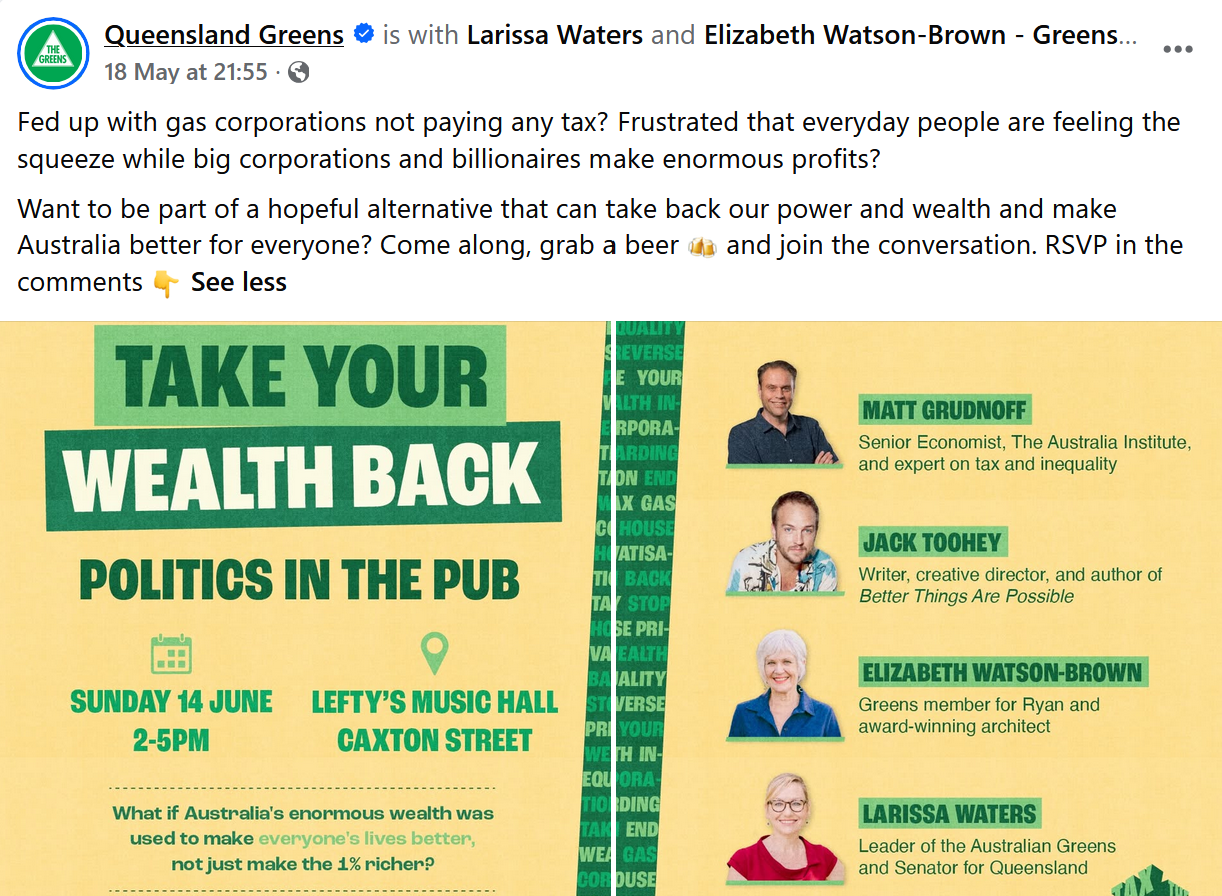
Slogans such as "take back your wealth" are obscuring where that wealth comes from, and reinforcing the notion that it's acceptable and fair to prioritise the needs and comforts of Australians ahead of the world's most oppressed and exploited communities.
Why this matters
To campaign strategists seeking to draw voters away from the far right, all this might seem like academic quibbling or a nitpicky distraction.
I can practically hear the eyes rolling in Greens HQ... "Of course we have to prioritise policies that primarily help Australians if we want to win seats in Australia! How many people will want to help refugees if they can't even afford groceries?"
But in Australia's current political context of rising fascism, that simplistic (and uncharitable) way of thinking about voters' motivations effectively acquiesces to a political contest on terrain which is far more favourable to racists and xenophobes.
Left populist calls to tax and redistribute wealth are intended to show that billionaires, not migrants, are the enemy, and challenge the false sense of scarcity that the far-right thrives on.
But fascist propaganda isn't necessarily arguing that there's not enough for every Australian – their core narrative revolves around global scarcity.
Fascists insist that (white) Australian lives matter more than the lives of people in other countries, and that there simply aren't enough resources to ensure everyone in the world enjoys a high quality of life. Left-wing political programs risk legitimising that fundamentally racist premise if they aren't foregrounding an anti-imperialist, internationalist vision for how the wealth of the mega-rich should be redistributed.
If most voters believe Australian politicians should only care about the people of this nation, and that to meet Australians' needs we must extract from non-citizens rather than sharing resources with them, the far right will continue to grow in power.
I'm not suggesting that taxing the 1% to fund services like free healthcare and free public transport is a bad idea, or is unpopular with voters.
But campaigning primarily for policies whose benefits stop at the nation's borders cedes ground in a deeper struggle over who and what voters should and shouldn't care about. If left populist parties inadvertently normalise nationalism and neo-colonialism in the name of winning votes, it becomes harder, not easier, to convince voters to care about refugee rights, or the genocide in Palestine, or global warming's impacts on the world's poorest communities.
Personally, I believe it's possible to ensure every one of earth's 8.3 billion humans can access decent housing, healthcare, education, food etc. without working themselves to the bone or destroying the biosphere. But doing so requires a more fundamental transformation of underlying systems and cultures.
Promising to fund free public services for westerners by taxing corporate wealth extracted from the Global South is not as revolutionary or utopian as it pretends to be.
By all means, campaign to tax the billionaires into non-existence and redistribute their riches. But let's not forget about the people and places who generated that wealth in the first place.

This website only exists because a very small proportion of readers have signed up for paid subscriptions. If you value writing like this and want it to reach a wider audience, please support this work with a $1/week subscription. Sharing it on social media helps a lot too!
 Jonathan Sriranganathan


Member discussion