It’s not too late for Brisbane to pull out of hosting the Olympics
The Brisbane Olympics isn’t ‘on the horizon.’ It has swallowed our horizon.
But a mega-event which is controlled entirely by humans is only inevitable if the majority of us in the host region continue to think and act as though it’s inevitable.
Saying “well the Olympics is definitely going to happen so there’s no point arguing about it” is not, in and of itself, a logical argument against Queensland withdrawing from its host city agreement with the International Olympic Committee (the IOC).
I'm less interested in debating what our politicians are most likely to do – I want an intelligent conversation about what they should do.
There may well be cogent arguments in favour of hosting, but simplistically declaring “the decision has been made and can’t be reversed” is a lie, and shouldn’t be the end of the conversation.
Ordinarily, summer Olympic hosts are only locked in 7 years in advance. So the IOC still has time to find a replacement (not that I think that’s our problem anyway).
Pulling out of the contract would be controversial, but it's not impossible. The key question is simply whether the costs of doing so outweigh the benefits.
In the lead-up to the 2024 state election, both the major parties understood how unpopular a big-budget Olympics was, and repeatedly promised they wouldn’t spend billions on new venues – a promise which Premier David Crisafulli broke within six months.
The latest independent estimates suggest it will cost the Queensland government at least $20 billion to host the Olympics. Some major costs, like security, are extremely difficult to predict this far out. So we're most likely looking at a $20 billion loss after you factor in all the anticipated revenue from ticket sales and private sponsorship, and assuming South-East Queensland won’t be affected by further major climate disasters (such as floods or heatwaves) over the next 6 years that would slow construction and drive costs up further.
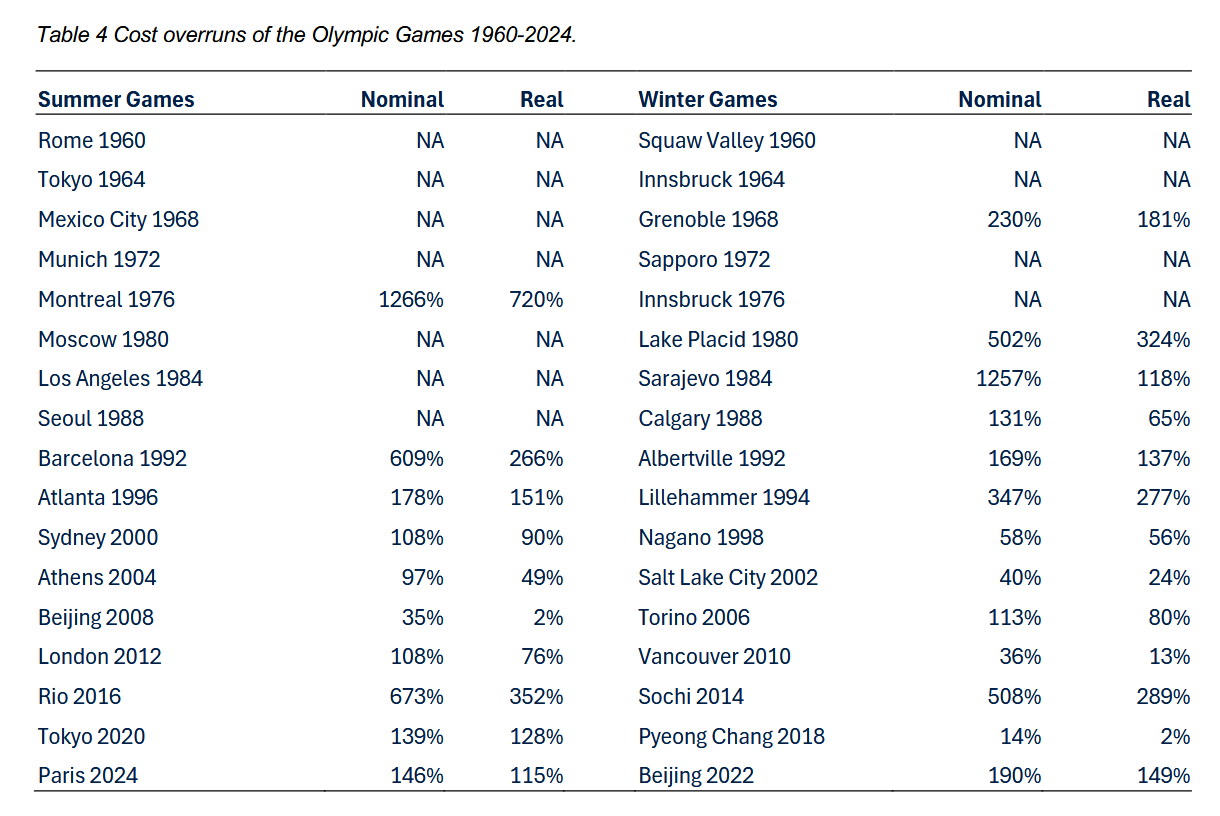
Interestingly, researchers from Oxford University have found that despite IOC commentary about wanting to encourage reuse of existing venues and support host cities to run more financially restrained games, recent summer and winter Olympics – including Paris 2024 – have experienced significant cost overruns.
The projected losses would be even bigger except the Liberal National Party is also currently selling off a couple billion dollars’ worth of public assets – predominantly large inner-city blocks of land that would otherwise have been used either for parkland or low-cost housing. Those land assets are strategically important for a growing city and would have continued appreciating in value, but the financial dunces of the Liberal National Party are offloading them to help fund construction of 30-year-lifespan* stadiums that will depreciate quickly.
One of the early arguments for hosting – that Queensland would use the Olympics to leverage greater federal investment in regional infrastructure – has proved to be spurious. SEQ isn’t getting any new federal government funding for public transport projects, time-sensitive bridge reconstruction or public space improvements as a result of taking on the Olympics burden.
Importantly, that conservative $20 billion figure – yes, that's twenty thousand million dollars – is only the direct cost to government. It does not include all the negative flow-on impacts of white elephant mega-projects and major event hosting, including:
- over-inflated rents and accelerated conversion of homes into short-stay accommodation leading to rising homelessness and tighter household budgets
- mass surveillance and widespread suppression of residents’ civil liberties
- rising construction and building maintenance costs for individuals and businesses due to spiking demand for labour, materials and equipment
- deferring and deprioritising crucial public projects that aren’t directly games-related
- significant loss of trees and green spaces, the value of which can’t be fully quantified in dollar terms, and certainly isn’t included on Olympics balance sheets
- the broader environmental harms such as higher fossil fuel emissions and consumption of non-renewable resources, none of which the LNP government is even pretending to attempt to offset.
 Jonathan Sriranganathan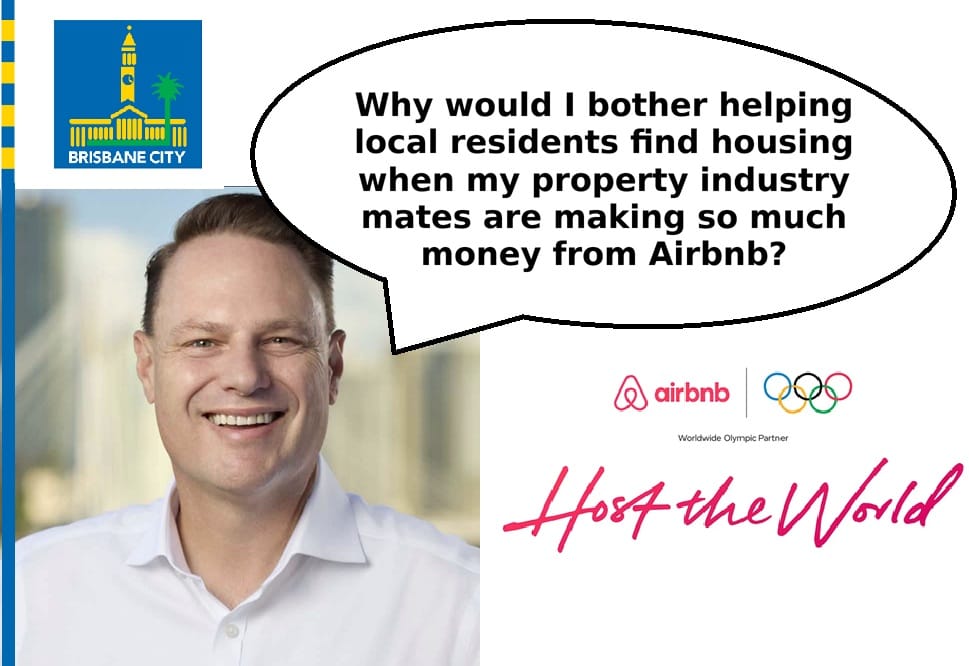
Decades of slick marketing have convinced most of us that the Olympics is primarily a sporting event. In reality, it’s a transnational profit-driven business juggernaut with some sport tacked onto the side.
It’s no coincidence that from the outset, some of the loudest advocates of a Brisbane Olympics were property developers, and that multiple members of Brisbane’s Games Independent Infrastructure and Coordination Authority (GIICA) board have a background in property.
Plenty of large corporations – construction and development companies, major tourism and events businesses, security and surveillance contractors etc. will take huge profits from a Brisbane Olympics (if we proceed). Hosting will undeniably deliver some wider benefits, but they’ll be unevenly distributed, and for most of us, the costs and negative impacts will far outweigh the positives.
Remember, the International Olympics Committee stitches up its own global sponsorship arrangements for the most lucrative elements of the games. It’s not like boutique locally-brewed beers are going to be served at Olympics venues – the IOC has already signed an exclusive supplier deal with AB InBev, the company that owns Corona. The same is true for many of the most profitable event-related services that Queensland businesses might have imagined cashing in on.
Water-muddying arguments about job creation also shouldn't be over-stated. Of course if a government spends billions of dollars on anything, it’s going to create a lot of jobs. But I’d much rather see jobs created building public housing, DV shelters, hospital wards, school classrooms, transport infrastructure or local facilities for community sport and recreation, rather than massive stadiums used primarily to generate profits for gambling companies and other big corporations.
Right now, the crucial question we should all be asking is: how much would it cost Queensland to pull out of hosting, and how does that compare to the likely costs and consequences if we proceed?
The closer we get to 2032, the more expensive pulling out becomes. There will come a point in the next few years – probably around 2029 - where the costs to government of compensating the private sector and the IOC for cancelling signed contracts would exceed the costs of proceeding.
But we’re not there yet.
Many of the games-related contracts that would be most expensive to renege on haven’t yet been finalised.
So much has changed in the world since early 2020 when Brisbane’s LNP-led council entered the only serious bid for the 2032 Olympics. From increasing risks of pandemics and climate disasters, to emerging technologies creating novel security threats, to new global conflicts which will continue causing supply chain impacts to everything from fuel to food.
Our host city contract with the IOC leaves us heavily exposed to global upheaval. Unforeseen price spikes and cost overruns are all born by Queensland taxpayers, as are shortfalls in anticipated revenue.
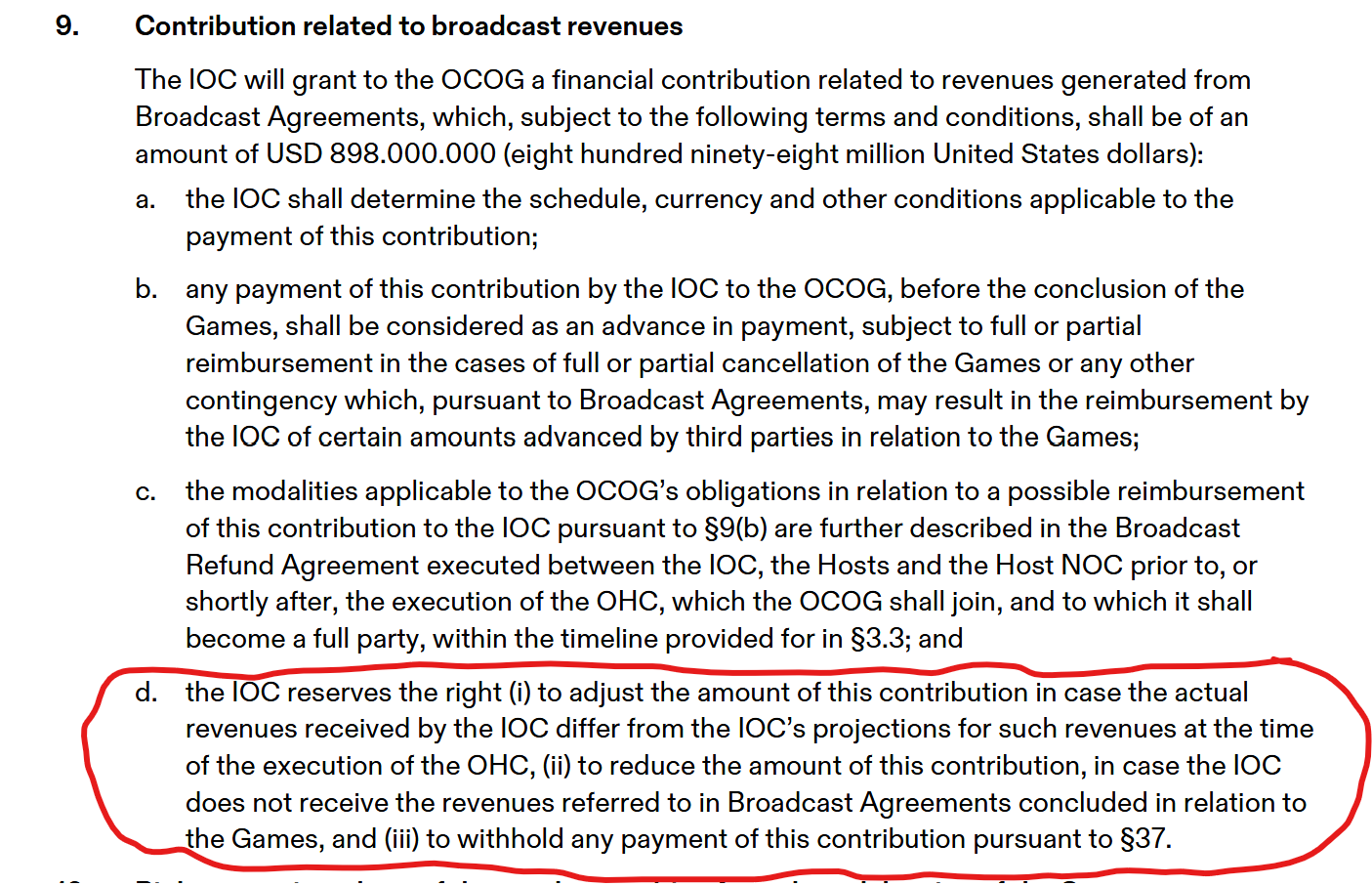
Even the IOC’s comparatively modest financial contribution to Brisbane 2032 (which, by the way, is hundreds of millions of dollars less than LA is receiving for the 2028 Olympics) is contingent on the IOC successfully securing lucrative sponsorship and broadcasting rights deals. So if American networks aren’t willing to pay as much as the IOC hopes, Queenslanders wear the loss.
All I’m saying is that we should at least be asking the question: How much would it actually cost Queenslanders to tell the IOC to find another host?
The push-ahead-at-all-costs crowd will of course raise the spectre of “damage to Brisbane’s international reputation.” But most people around the world would grudgingly respect a city that made the tough but responsible financial decision to pull out of such a bad deal.
Undeniably, withdrawing will likely impact Queensland’s ability to attract other major international events in the next few years. But given that most mega-events are loss-making propositions for the public purse anyway, the value of those hypothetical future missed opportunities is negligible compared to the $20 billion+ cost of proceeding.
The reputational damage to the IOC would be far greater. So if Queensland signals that it’s seriously considering withdrawing from hosting, that would at least give us more negotiating leverage to extract greater financial support and contract delivery flexibility.
I’m not claiming the games will be an all-out disaster.
If the two major parties proceed with what’s essentially becoming a blank-cheque approach, Brisbane 2032 may well prove to be a vibrant, well-attended event that raises the city’s international reputation and showcases some inspiring moments of athleticism and international camaraderie.
It’s the rest of the state that’ll suffer: Public transport and public housing projects that go unfunded... Hospital and school upgrades that never get past the drawing board... Widespread environmental destruction... Rising homelessness... Deep, compounding harm to relationships with First Nations people... Cuts to a thousand smaller government services and programs that had tangible positive impacts on people's lives, but whose disappearance won't even make the news...
For the Queensland government, one of the deeper negative impacts of pushing ahead will be entrenching the resentment and distrust of a large proportion of the state’s population. I’m talking about the millions of Queenslanders – particularly in rural areas and in South-East Queensland’s poorer, under-serviced sprawling outer-suburbs – who are under increasing financial stress, never wanted us to host, and rightly recognise that their pro-Olympics leaders are prioritising big business ahead of homeless Queenslanders sleeping in cars and severely ill hospital patients who can’t access decent healthcare.
As someone who’s deeply critical of nation-states and hierarchical capitalist governments, I’m not especially concerned that the LNP’s pro-Olympics bloody-mindedness will further corrode public faith in centralised government. But I’m mindful that grievances arising from feeling disillusioned and neglected can be weaponised by fascist reactionaries in ways that will ultimately harm all of us, with lasting consequences long after the 2032 economic sugar-hit has evaporated.
As resentment grows, the LNP may well try to blame Labor for signing us up to host (which is an audacious lie given that the LNP-led Brisbane City Council initiated and drove the bid, securing support from Liberal Prime Minister Scott Morrison long before Queensland Labor got on board). But the LNP still has the power to withdraw from the host agreement. Responsibility for not doing so will rest primarily with Premier Crisafulli and Lord Mayor Schrinner, and perhaps also the federal Labor government who are enabling this madness by giving Queensland several billion dollars of funding for venue construction.
Despite this, I don't foresee any direct electoral repercussions for the major parties on this front unless other political actors take a more assertive anti-Olympics position.
At the very least, we must insist on a cool-headed analysis that focuses on the public interest (including environmental sustainability) as distinct from corporate sector interests.
 Jonathan Sriranganathan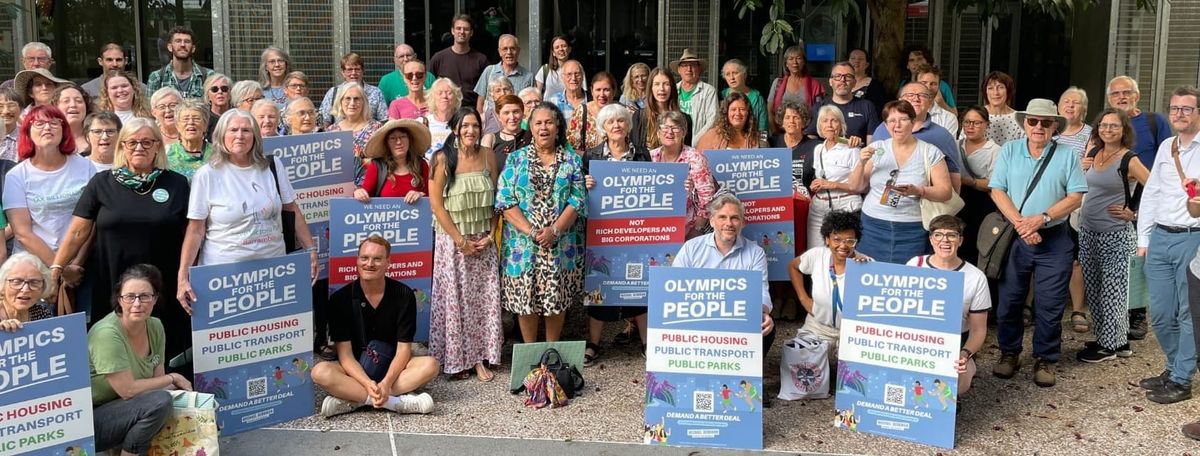
One of the stranger, more perverse impacts of Brisbane 2032 is that it requires its evangelists to deny the reality of what the world will look like 6 years from now.
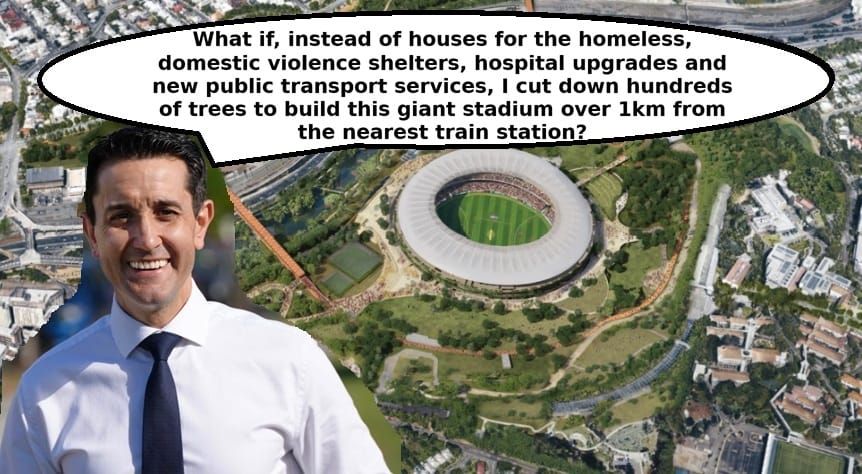
Other governments will be spending billions transitioning from fossil fuels to renewables, relocating entire neighbourhoods in anticipation of rising seas and more frequent coastal storm surges, and maximising the reliability of water and food supplies for a future of more severe droughts and famines. Meanwhile Queensland will be expending its finite resources to build stadiums that aren't even within easy walking distance of train stations (the actual walking distance for a fan coming from the Exhibition train station to the closest side of the proposed Barrambin stadium looks like it would be about 1 kilometre).
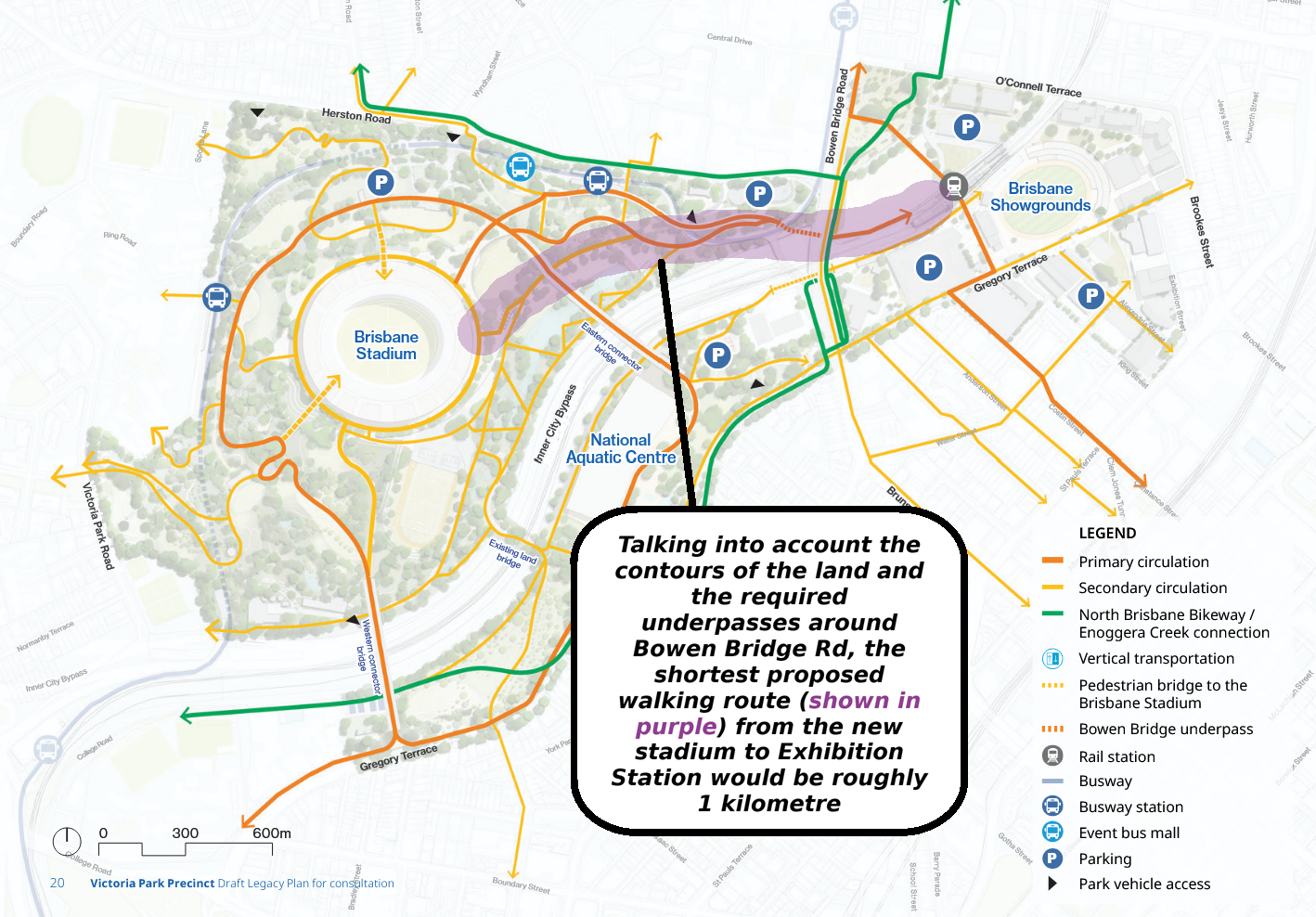
If we don’t want to pull out altogether, the least we can do is revert to the original proposal – a financially conservative, low-impact games that utilises existing venues, prioritising environmental sustainability and the interests of Queensland residents ahead of corporate profits.
But right now, my vote would be to cancel Brisbane 2032 and tell the IOC to find some other sucker to exploit.

*I suggested the new stadium at Barrambin will have a lifespan of 30 years. I used the term 'lifespan' as it is commonly deployed in conversations about major venues, that is, how long it is likely to continue being used for the class/tier of events it was designed for before the sports industry establishment insists it requires a major upgrade/reconstruction.
In the absence of government commentary to the contrary, I think it's reasonable to assume the proposed Barrambin stadium will reflect the contemporary global pattern of modern stadiums being treated by capitalists as 'too old' after about 30 years. This has certainly been the experience in Brisbane, and indeed most Australian cities.
For example, the QSAC stadium built at Nathan for the Commonwealth Games in 1982 is now considered too old to use for major events without a substantial rebuild.
Similarly, the Gabba stadium, which was built in 1993, and underwent multiple major upgrades concluding as recently as 2005, is already considered 'too old' and is proposed to be demolished after 2032.
Thanks for reading. I would write stuff like this more often if more people subscribed to support me to do so.
If you don't want to live in a world where literally everything you ever read is produced by AI slop machines regurgitating unoriginal ideas, now is a good time to chuck a couple bucks towards some independent human writers...
 Jonathan Sriranganathan
 Jonathan Sriranganathan
 Jonathan Sriranganathan

Member discussion