Fool's gold: Have the QLD Greens picked the wrong lane for the Olympics?
It's 2020, the dawn of the 21st century's third decade. Covid-19 is killing millions across the world, homelessness and poverty are rising rapidly across Australia, and tens of thousands of people in our city have been taking to the streets to call for climate justice and an end to systemic racism. At the same time, many of the most powerful people in Brisbane are spending long hours in private meetings....
"What were they talking about?" you may well ask.
Those politicians, property developers and business execs weren't meeting to discuss pandemic responses or housing policy or global warming or the Black Lives Matter movement.
They were plotting to ensure that our city would host the 2032 Olympics.
While Queensland Labor is often blamed for signing us up to host, the push initially came from the LNP-dominated Brisbane City Council. Graham Quirk and Adrian Schrinner eventually convinced Liberal Prime Minister Scott Morrison to back the bid, and it was only after both the local and federal governments joined in calling for Brisbane to host that Annastacia Palaszczuk and the Queensland government grudgingly came to the table.
While the bid had been in the works for years, the definitive city council vote took place on 23 March, 2021.
I was the only city councillor to vote against Brisbane hosting the Olympics (my main reasons were outlined in this post). Despite hosting being supported by most of the media, by Liberal, Labor and Independent councillors, and of course by lobbyists for major industries like property development and tourism, I was reassured to discover a large chunk of the general public seemed to be on my side.
Yesterday, Brisbane City Council voted on whether to commit to hosting the Olympics in 2032 (assuming the International...
Posted by Jonathan Sriranganathan on Tuesday 23 March 2021
Strangers in the street stopped to congratulate me on saying 'no.' Even some people who really loved the Olympics could see actually hosting it was a bad proposition for Brissie.
So I was surprised and disappointed that over the next few years, other state and federal Greens reps didn't come out as strongly against hosting as I had. Greens MPs helped run a strong campaign opposing the proposal to demolish and rebuild the Gabba as the main stadium (which would have shut down the area's only public school), but key spokespeople stopped short of saying publicly that we should pull out of hosting entirely.
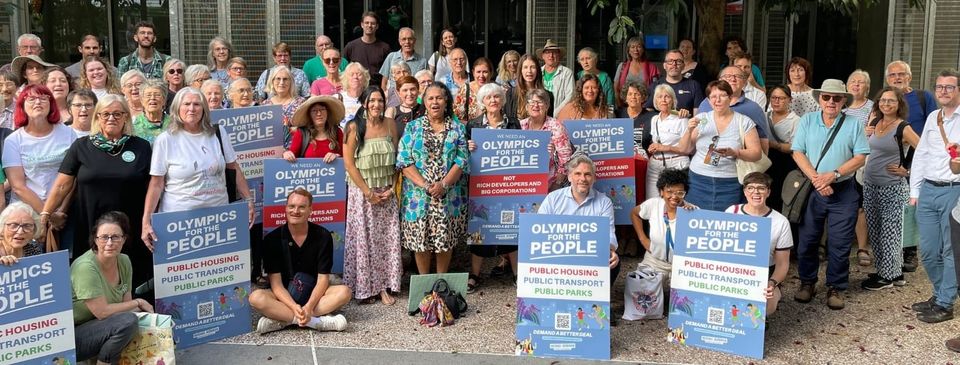
Now in 2026, the latest messaging from Greens state MP Michael Berkman and federal MP Elizabeth Watson-Brown revolves around "an Olympics for the people." Michael's website explains: "Our Olympics for the People campaign is a six year push for a better deal for Queenslanders."
Basically this seems to be about saying 'the Olympics are coming and we can't stop that, but what would have to change in order to ensure hosting the Olympics delivers a positive legacy for our city (and the wider state)?'
Elizabeth Watson-Brown's speech in the House of Representatives on 24 November, 2025 (page 165 of this PDF) exemplifies this political orientation, with phrases like "the Brisbane 2032 Olympics Games are an opportunity to leave a lasting and positive impact for the regular people of Brisbane" and "We have a once-in-a-generation opportunity to reshape our city." While Libby's goals obviously differ, these kinds of lines wouldn't seem out of place in a property industry conference or a Liberal party fundraiser.
$15B for zero new homes or public transport?! We can get a better deal from the #brisbane2032 #olympics 💚
Posted by Elizabeth Watson-Brown - Greens MP for Ryan on Friday 27 February 2026
I was grateful to be invited to speak at Elizabeth and Michael's recent "Olympics for the people" summit. It featured insightful speakers and prompted some great discussions. But I worry their overall "people's Olympics" narrative is both ineffective for building Greens political support and intellectually dishonest, in that it conveys the false impression that an ethical or net-beneficial Brisbane Olympics is even possible.
In thinking through whether the Greens are taking the right strategic approach, I flicked off some questions to Elizabeth and Michael. To their credit, Michael Berkman replied (on behalf of both of them) with a detailed and thoughtful response. Rather than cherrypicking, I figured I'd republish my questions and his answer here in full, before diving into further analysis.
Here's what I asked:
- Considering all the likely social, economic and environmental impacts, do you agree that it's impossible for South-East Queensland to host an Olympics that's overall net-beneficial for our city and the world?
- If you think an ethical Olympics event is possible, what policy priorities would you consider necessary to ensure the positives outweigh the negatives?
- Does the Greens push around an 'Olympics for the people' reinforce the flawed premise that hosting an Olympics can be a good thing, and thus weaken opposition to specific negative impacts? For example, if the public accepts the general proposition that a 'good' Olympics is possible, isn't it then easier for conservative politicians to argue that key projects like the Barrambin stadiums must proceed?
- For several years now, the Greens have avoided taking a firm, outright anti-Olympics position, and instead focused on positively-framed demands like "we need athletes village public housing" and "we need more public transport investment" (alongside our critiques about negatives like the Barrambin stadiums). This strategic approach seems to have yielded no tangible victories or concessions – why double down on it when it doesn't seem to be working?
- Thinking strategically, if the Greens' goal is to extract as many positive concessions and outcomes as possible, isn't it stronger and more effective to start with a firm negotiating position of "the Olympics are terrible and will cause lots of harm" to pressure the establishment into placating concerns and delivering some of the things you're calling for?
- The Greens seem to be appealing to voters who want to see the positives of hosting the Games and who are turned off by 'party-pooper Greens' who 'say no to everything.' But presumably, as the Games draws closer, the Greens will be siding publicly with First Nations-led protests against the games, with criticisms of expanding surveillance and securitisation, and with global justice movements calling for Olympic boycotts on the basis that countries like Israel are participating, at which point the Greens are inevitably going to turn off the pro-Olympics crowd anyway. Are you chasing a constituency that you have no hope of retaining?
- Do you have any robust, statistically representative public opinion data suggesting that the majority of Queenslanders are broadly and unwaveringly pro-Olympics?
- If your electorates of Ryan and Maiwar are majority pro-Olympics, but Queensland voters as a whole lean towards Olympic scepticism, should you represent your own voters' views or the views of the Queensland/Australian public as a whole?
Here's Michael's response:
"Regarding whether a ‘good Olympics is possible’, our current thinking, and this was also discussed at a workshop at a state council, is that there needs to be a separation between people’s love of sport and enjoying a big event, from the economics and power relations embedded in the Olympics as they play out in our system.
There is no essential reason why there couldn’t be an Olympics event that is run in the interests of everyday people. To genuinely pull that off would likely require a paradigm shift in our government and economic system, but that’s part of the purpose of the approach we are taking.
Regarding the idea that an ‘Olympics for the people’ stance might “weaken opposition to specific negative impacts”, we think the answer is the opposite. It is because the campaign is aimed at raising people’s expectations, and suggesting that there should be a way to deliver an Olympics in a way that benefits everyone, that we are more able to critique the negative impacts (such as privatisations of public land, house price/rent increases, etc), since we’re pointing to a concrete alternative the government should or could have taken.
People will rightly understand that the Olympics won’t be stopped, and we think that means an entirely anti-Olympics position will mean that the critiques of the negative elements won’t reach a wider audience of everyday people.
It is important that the polarisation we’re drawing is not “Olympics vs everyday people”, certainly not “big sporting event vs everyday people” – it is between an Olympics run by and for the rich vs something that works for regular people.
To suggest this approach should be dropped because we haven’t won any concessions yet is premature – the Greens have only just started putting significant energies into this, and it's not clear that a directly oppositional approach would be more successful.
The Greens are, or should be, a coalitional party. We will indeed continue to support groups that oppose the Olympics on various grounds if they align with our values, but there is no essential reason that these can’t be brought within a frame of an Olympics for the People.
The meta level approach of an Olympics for the People in no way precludes vigorously supporting (or even initiating) a campaign to stop the privatisation of public land, or opposing wasteful, destructive stadium projects, and our reps are working on those campaigns already."
I really appreciate that Michael took the time to provide such a comprehensive response. If you emailed these kinds of strategic questions to most other Queensland politicians, you'd be lucky to get two or three sentences of contrived spin, and probably wouldn't receive a reply at all.
Generally speaking, I think Michael is doing a great job as an MP. His team pretty reliably make the right calls when presented with tough strategic choices. But having read through his reasoning on this issue, I find myself wholly unconvinced.
Does the Greens position win over swing voters and/or meaningfully impact political discourse?
To disengaged/inattentive voters, 'Olympics for the people' messaging is barely distinguishable from an uncritical 'pro-Olympics' position, particularly when summarised and simplified for media dissemination. Unfortunately, Queensland Greens MPs currently don't have the reach to communicate a more detailed, nuanced message (except perhaps to their own small mailing lists and existing supporter bases).
The Greens aren't going to win many votes off the major parties by being seen as pro-Olympics, especially in a context where the Queensland Labor opposition is also broadly pro-Olympics but critical of the LNP's public asset sell-offs and excessive spending on stadiums. There are more votes to be won with a message of strong Olympics scepticism.
Leading into 2032, as venue construction costs balloon, civil liberties are stripped away, and low-income renters are evicted so their homes can be turned into Airbnbs (side note: Airbnb is a major Olympics sponsor), the Greens' current Olympics messaging and orientation will not position them well to capitalise on growing voter frustration with the mega-event. But it also doesn't seem likely to win any significant policy changes.
Right now, neither the LNP nor Labor pay much attention to Greens policy demands unless a groundswell of public support for a Greens proposal makes the major parties worried about losing votes over the issue (the most significant recent example of this is the Queensland Greens demand for free public transport leading to the introduction of 50 cent fares).
So if a Greens announcement or policy demand doesn't resonate with a large chunk of the general public, it generally has negligible influence over government policy-making.
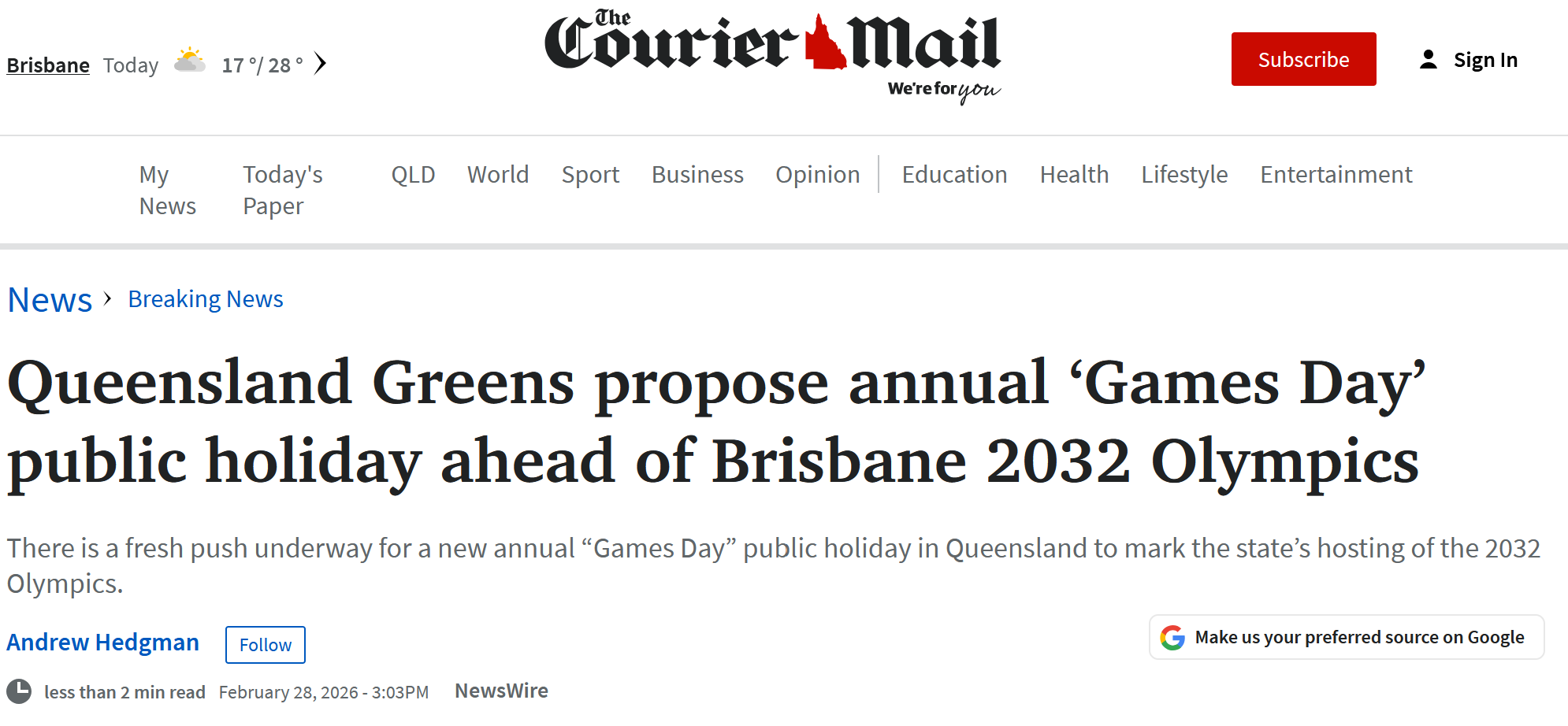
The harsh reality is that the Greens' initial media push regarding "a people's Olympics" made no discernible dent in Queensland's political discourse. Elizabeth and Michael attracted some limited mainstream media coverage focussed on their calls for an Olympics public holiday, but the story dropped out of the news cycle pretty quickly. Their social media assets also didn't travel very far online.
This is in part because aside from the public holiday idea, the 'Olympics for the people' campaign isn't calling for anything new or sensational enough to gain online traction – the Greens have already been pushing for more investment in public housing, public transport, waterway restoration etc. for years.
But I also suspect it's because at a deeper level, the messaging just didn't strike a strong chord for many Queenslanders.

If, like me, you think the Olympics is an irredeemably negative phenomenon that's a waste of resources and a distraction from more important issues, Michael and Elizabeth's framing doesn't work for you, because it comes across as too sympathetic to the Olympics (especially in terms of how the media reported it).
Whereas if you're already firmly pro-Olympics, calls for more frequent public transport and for athlete villages to become public housing might reinforce your view that the Olympics can be a good thing, but probably aren't exciting enough to motivate you to join a campaign or even share social media posts.
And if you don't have strong opinions about the Olympics either way, nothing about this campaign is striking enough to grab your interest.
Most Queenslanders will fit into one of those three groups. I suspect a majority would lean towards scepticism or outright hostility to the Olympics, but I don't know for sure. Neither do the Greens.
Michael's response didn't answer my question about public opinion polling. I take this as confirmation of what I already assumed – Greens MPs and strategists have no independent statewide polling or survey data telling them what the general public thinks of the Olympics.
So in deciding what messages will play well with the electorate, Michael and Libby's offices are relying on rough impressions based on general mainstream media discourse, and on the tone of commentary from the small subset of voters who proactively contact MPs (and who aren't necessarily representative of the wider Queensland public).
Right now there are no indications that an "Olympics for the people" message is going to win over lots of voters, which in turn means this campaign isn't giving Greens MPs any additional leverage over the major parties regarding demands like public housing investment.
Michael's suggestion that "there's no evidence that a directly oppositional approach would be more successful" seems to ignore the experience of the global NOlympics movement; activists organising across different host cities over many years have found they gain greater public traction and leverage by articulating a robust, unapologetic critique of the Olympics as a whole, rather than merely calling for reforms to Olympics delivery models.
Jonathan Sriranganathan
My deeper concern though, is that in suggesting "There is no essential reason why there couldn’t be an Olympics event that is run in the interests of everyday people," Greens spokespeople are ultimately deceiving themselves and their followers.
A 'good' Olympics is impossible
It’s well-established that hosting the Olympics is a loss-making proposition. The world comes to have a party, while locals bear the costs for years to come. The International Olympic Committee's (IOC) host agreement heaps all the risk and cost onto Queensland – there's no way to avoid this liability while proceeding as a host.
But even if Brisbane were to somehow run a profitable Olympics and use the money to pay for good stuff like public housing or cleaning up the river, that profit margin would only be possible through some combination of exploiting workers, ripping off tourists, giving advertising platforms to unethical multinational corporations, and unsustainable exploitation of the environment.
Even ostensibly pro-capitalist liberals understand the Olympics is a dud proposition for host cities
In terms of workforce, total population, gross regional product, and housing stock, South-East Queensland will be the smallest Summer Olympics host in decades. While larger host cities like Beijing, London, Rio de Janeiro, Tokyo, Paris and Los Angeles might be better able to absorb the impacts of such a major event, a smaller city like Brisbane will feel them more dramatically.
Brisbane is already seeing the upward pressure on housing costs, construction material and workforce capacity shortages, and delays to urgent, essential projects that would otherwise take priority if not for the Olympics. Cost overruns will most likely be financed by public asset sales and/or increasing state debt.
Importantly, hosting doesn't involve the IOC handing Queensland any additional funding for public infrastructure, environmental restoration or any of the other 'positive legacies' that might hypothetically flow from an Olympics, and the IOC's financial contribution doesn't cover the full operational costs of running the games. Hosting means Queensland has less money to spend on essential public infrastructure and services, not more.
At best, hosting gives South-East Queensland another argument that it deserves a larger share of federal government public funding than other parts of Australia. But five years on from Brisbane winning the bid, that argument hasn't translated to anything concrete. The only federal contribution has been $3.4 billion towards building stadiums we don't need.
There's no practical reason why Greens demands for public housing and other infrastructure need to be linked to the Olympics. Any funding the government might use to build more public homes, rail lines or bike lanes could be spent on those projects even if the Olympics weren't happening.
But let's be generous to the Greens and assume hosting did somehow contribute to better public transport services, a major public housing boost, more parks and community facilities, improved natural habitat spaces, more investment in the arts and cultural institutions etc. Even with all that included, the Olympics would still be deeply problematic...
The shit is baked in
The host city has no control over major IOC sponsorship agreements with deeply problematic corporations like Coca Cola and Airbnb. There's no way for Brisbane not to platform these brands unless we pull out of hosting altogether. –
Top-level sponsorship agreements include exclusive venue catering rights. So locally-brewed beers and Queensland institutions like Bundaberg Ginger Beer will not be sold at Brisbane 2032 stadiums – only Coca Cola soft drinks and AV InBev beers (they own Corona) are allowed to be sold.
There's also currently no ecologically sustainable way for hundreds of thousands of people to fly all the way to Brisbane for a 2-week event. Once you factor in all the impacts of an event like this, a 'carbon-neutral' or 'environmentally sustainable' games will never stack up. Revenue from ticket sales, broadcasting rights and corporate advertising will never be enough to cover the costs of mitigating the negative environmental consequences.
From a governance perspective, the distraction factor is significant. In our hierarchical political system, time-poor government ministers, mayors and senior department officials frequently become decision-making bottlenecks. Every hour that the Queensland premier, a city council committee or a group of public servants spends planning or reviewing some element related to hosting the Olympics is time that could and should be spent addressing myriad other more pressing issues.
At a broader level, the Olympics is basically a pissing contest between competing imperial powers and extractivist petrostates. Medal tallies primarily reflect how much money different countries are able and willing to allocate towards supporting and training athletes, reinforcing the entrenched inequalities between the winners and losers of neoliberal capitalism.
The entire exercise in competitive nationalism is highly politicised, reflecting many of the biases and injustices inherent within the current global order (take, for example, the IOC's decision to exclude Russia from the 2024 Paris Olympics while supporting Israel to participate, or the ongoing practice of describing the Taiwanese team as 'Chinese Taipei' so as not to aggravate China).
Underneath the glossy facade, the Olympics is not so much about nations putting aside differences to compete in a spirit of harmony and friendship, as it is a consumerist profit-fest for multinationals and a massive PR exercise in sportswashing colonialism, imperialism and all manner of human rights abuses by major powers and their allies.
I'm not saying the Olympics is all bad. Of course there are also positives that flow from sharing a collective experience where you feel connected to millions of people around the world who are watching the same impressive feats of human strength and skill. But the negative costs and effects outweigh the positives, especially for the host city.
The most generous reading of the Greens approach is that they know a genuinely 'net-good' Olympics is impossible under the current colonial capitalist global order (Michael's comment about a "paradigm shift in our government and economic system" alludes to this). So starting a conversation about what would have to change for a true "people's Olympics" to be possible is just a tactic to lead followers along a very long journey towards critiquing imperialism and neoliberalism. But that's an incredibly slow, indirect and inefficient way of trying to teach Queensland voters that 'capitalism = bad.'
And if your argument for a "people's Olympics" is actually premised on a major political and economic paradigm shift, it seems odd to then argue that "People will rightly understand that the Olympics won’t be stopped." Why is stopping the Olympics considered more farfetched than transforming entire political and economic systems?

Perhaps what's ultimately going on here is that Greens strategists have confused "meeting voters where they're at" with "parroting back voters' knee-jerk opinions about an issue that they haven't given much thought to."
If you simply ask someone "what do you think of the Olympics?" after they've been bombarded with pro-Olympics propaganda from politicians, the property industry and the IOC, maybe they'll say something positive about it. But it won't be a deeply-held, unshakeable conviction.
I've had plenty of conversations with people who have a default positive orientation towards the Olympics but who, once offered an alternative perspective to the IOC's spin, will agree that we'd be better off putting our resources and time towards something else.
The Greens have a responsibility to educate the public and explain the significant flaws and harms associated with the Olympics, rather than watering down the critique because they've concluded (based on vibes rather than hard data) that voters will be turned off by it.
As alluded to in my questions to Michael, over the next few years the Greens will likely support various protest causes that will be perceived as derailing or undermining Olympics preparations. This will ultimately turn off strongly pro-Olympics voters despite Greens attempts to find an illusory middle-ground. So the party will be better off electorally if it can convince more voters of the truth – that the Olympics are, on balance, a bad thing.
The silver lining for the Greens is that the "Olympics for the people" campaign has so far gained so little traction that the party could easily still pivot towards a more oppositional stance without it seeming like a major backflip. If MPs are worried about turning off some voters by being too negative, for now it would perhaps be better not to talk about the Olympics at all. But one way or another, the Greens will have to decide where they really stand eventually.

Thanks for reading! To keep these articles freely available to the wider public, and support me to write more stuff like this, please consider signing up for a $5/month subscription...
Jonathan Sriranganathan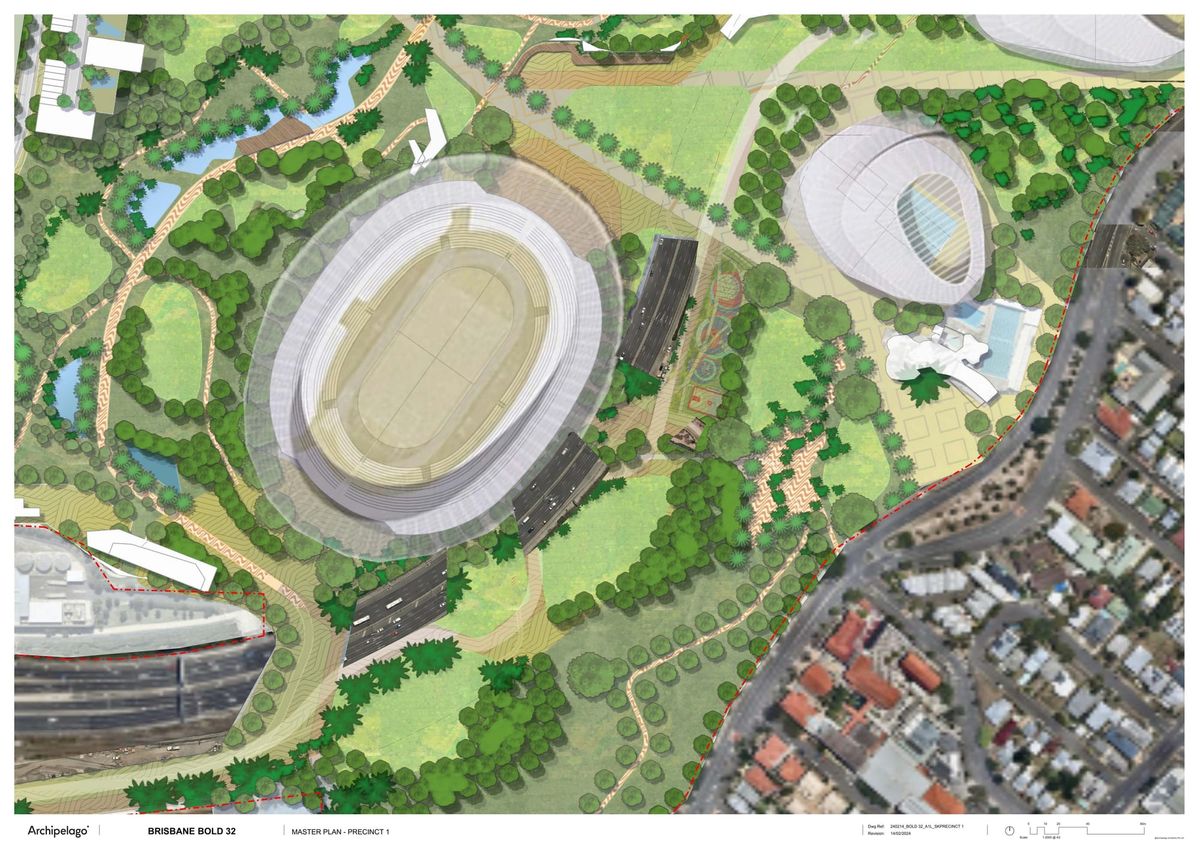
Member discussion