How might the upcoming change to Brisbane City Council ward boundaries impact the Greens’ chances?
Yes I know. It’s hard to imagine a drier topic than local government ward boundaries, so I'll keep this short.
But it is important: the dominant political currents on Brisbane City Council have a disproportionate, tail-wagging-the-dog influence on wider Queensland politics, and how BCC ward boundaries are drawn can impact how many seats each political party wins.
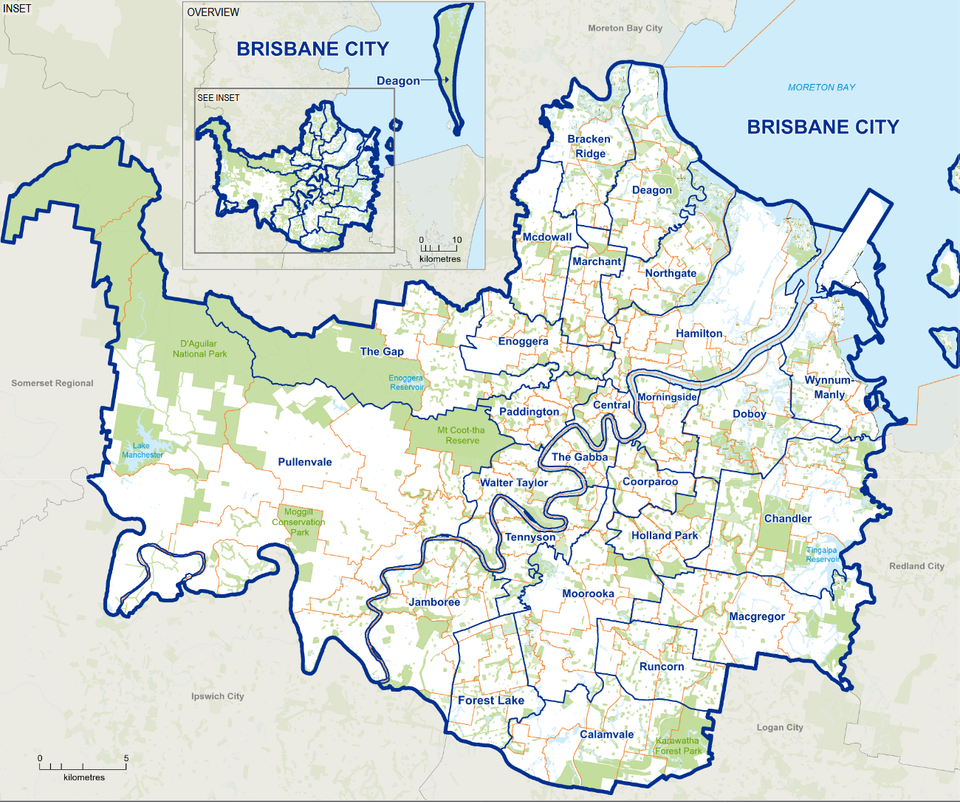
For the first time since 2019, the Local Government Change Commission (LGCC) is reviewing the boundaries of Brisbane’s 26 wards to make sure they all have roughly the same number of voters – public submissions opened on Monday, 16 November. After considering submissions, the commission will propose new boundaries, then invite another round of public submissions before finalising the boundaries sometime next year.
Data released by the LGCC alongside their call for public submissions shows that since the last boundary review, voter populations are (in general) growing fastest in inner-city neighbourhoods and one or two outer-fringe areas. Meanwhile most suburbs have seen comparatively little densification and population growth.
(As an aside, that’s a serious concern from a sustainable urban planning perspective, because it’s those low-density middle-ring suburbs with train/metro stations and existing community infrastructure that arguably need to densify a little more. But in recent decades the major parties have preferred to concentrate development in just a couple of inner-city neighbourhoods with inadequate infrastructure and facilities, while replacing farmland and forest with more suburban sprawl on the city’s outer fringe, leaving affluent middle-ring suburbs – Ascot, I’m looking at you – largely untouched by population growth.)
If every ward had exactly the same number of voters, that would work out to 33,207 voters per ward based on August 2026 enrolment figures. Right now, some wards, such as Calamvale, contain way more voters than that, while others have far fewer. State government predictions for future population growth suggest the discrepancies will get worse before the 2032 elections.
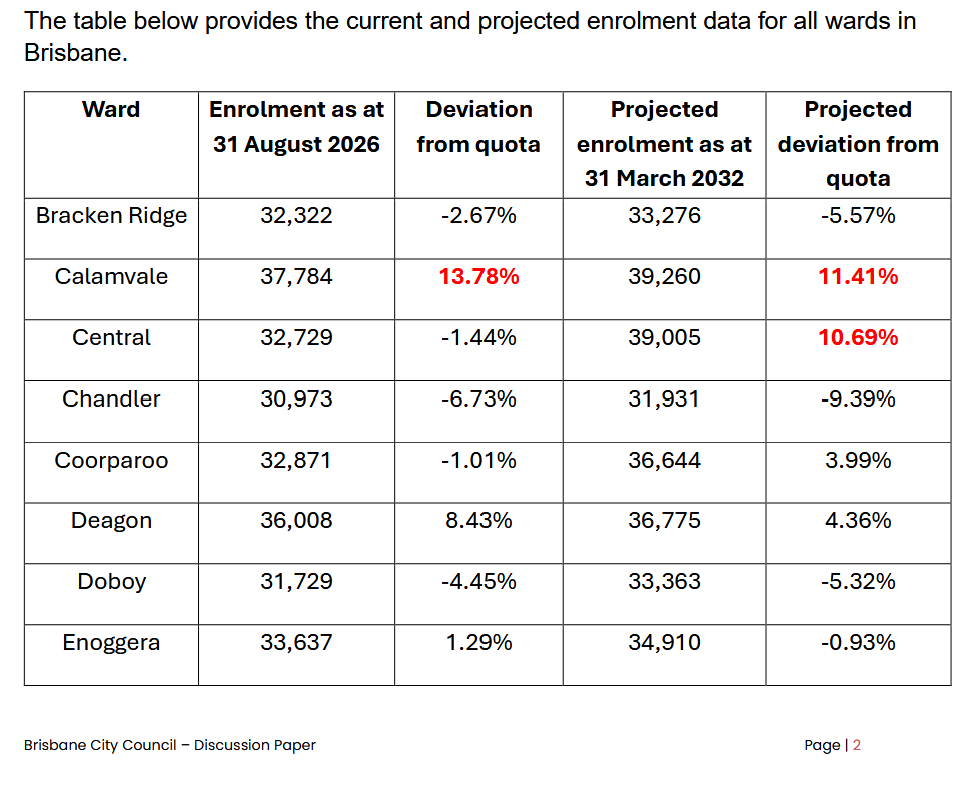
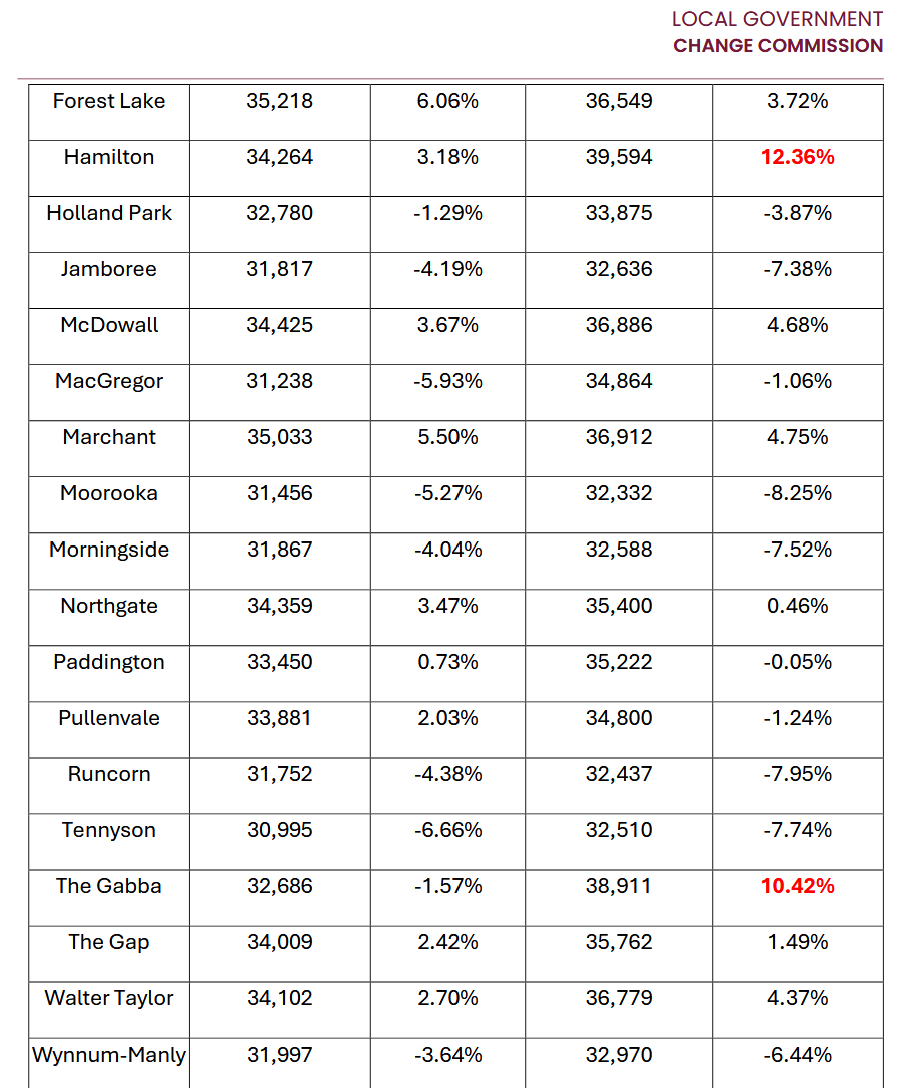
Table from the Change Commission's Discussion Paper
While the phenomenal recent growth in Calamvale ward means its boundaries need to shrink more significantly, that's not too tricky to resolve, as the neighbouring wards of Moorooka and Runcorn are both well below the target average.
Because Central ward and the The Gabba ward continue to grow faster than most suburban wards, their boundaries will have to shrink in order to even out the number of voters per ward across the city, but Hamilton ward’s voting population is also growing rapidly because of significant densification around Northshore.
As the commission is trying to even out the number of voters in each ward, it’ll want to expand the boundaries of wards which are currently below average (so shifting the boundaries of Hamilton – which is already well above average – towards the city wouldn’t help as much).
Chandler needs to expand its boundaries, but the surrounding wards of Doboy, Holland Park, MacGregor and Wynnum-Manly are all also below quota.
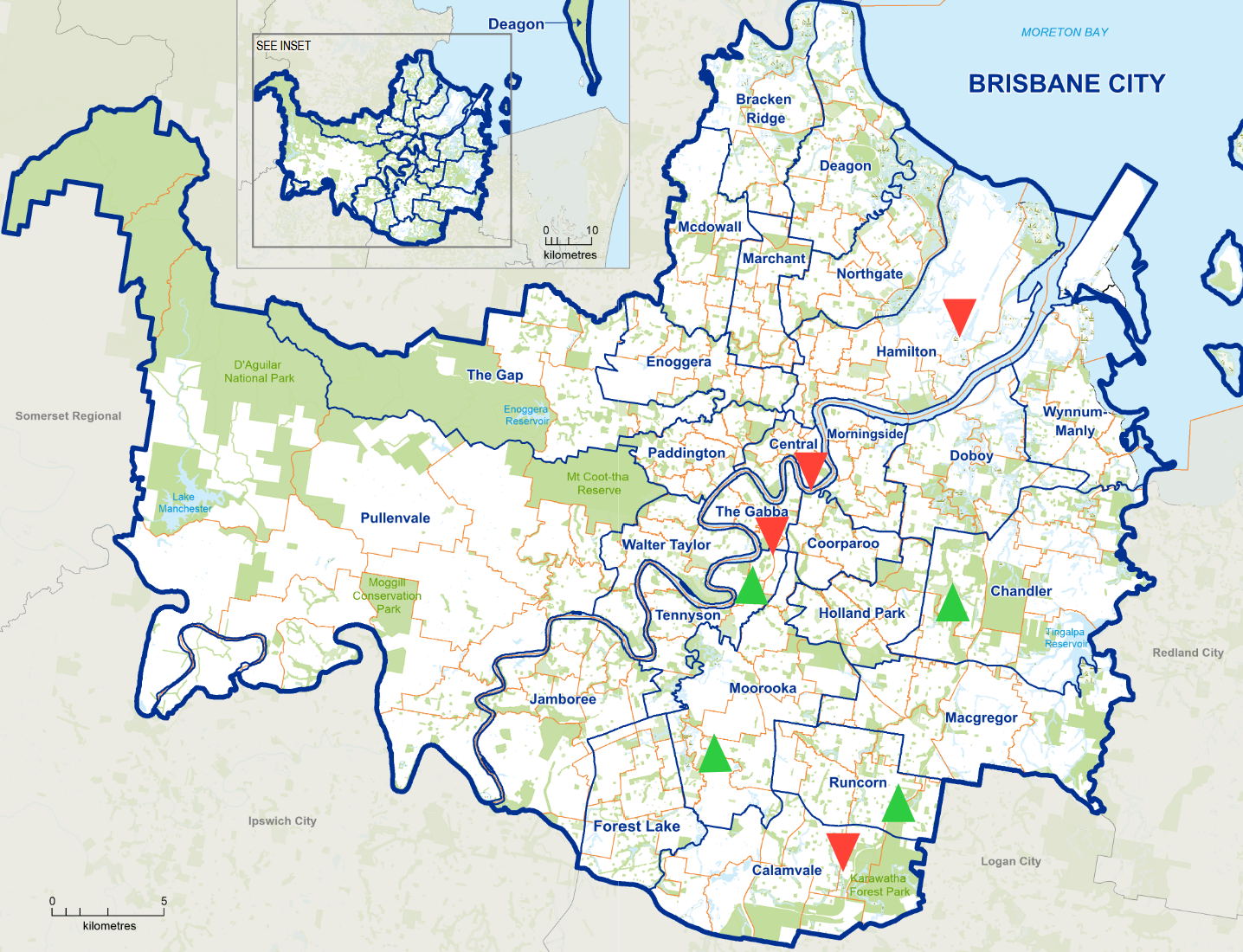
All this means the boundaries of slower-growing middle-ring wards such as Paddington, Tennyson and Holland Park will most likely have to shift closer to the city, which in turn might lead to wards like Northgate, Enoggera and Coorparoo moving too.
What shape the new wards take on is arguably less electorally relevant than the general pattern that there are higher proportions of renters and public transport users the closer you get to the city centre. People who are less car-dependent and/or who don’t own real estate tend to vote 1 Greens at higher rates.
So while the proportion of Greens voters in existing Greens-held wards of The Gabba and Paddington should remain high enough for the party to retain those seats comfortably, the increasing proportion of Greens-leaning active travellers and young renters within the adjusted boundaries of wards like Enoggera and Holland Park will make it harder for the LNP to retain them.
The boundaries of LNP-held Central ward will also have to shrink, although it’s harder at this stage to predict whether that will help or hinder the Greens. Among the thousands of young renters in Fortitude Valley, the Greens vote is huge, whereas the gentrification of some parts of New Farm and Teneriffe has led to an influx of wealthier gen Xers and baby boomers who might tend to lean right-wing. So exactly how the new boundaries for Central ward are drawn could be a key variable in terms of whether the LNP hold this seat or it swings to the Greens.
I'm curious to see what happens to my former electorate of The Gabba. The simplest solution may be to expand Tennyson Ward's boundaries to take in part of Dutton Park, but given that most of The Gabba's recent and projected population growth will be concentrated more around the suburbs of South Brisbane, Kangaroo Point and the northern half of Woolloongabba, that might not solve the long-term issue.
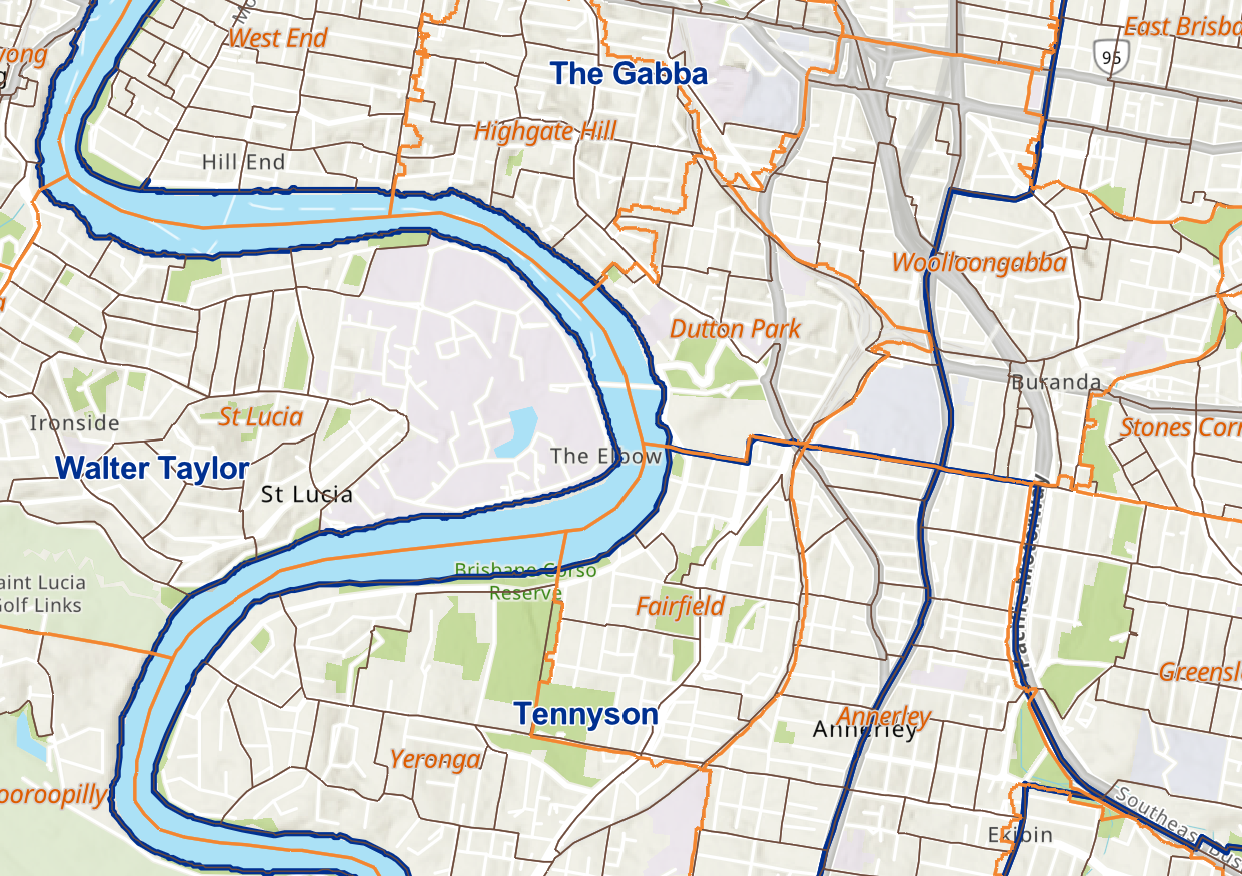
Interestingly, it’s possible Hamilton Ward could lose some of its most conservative neighbourhoods to Northgate Ward, which coupled with more tertiary-educated professionals moving into all the new highrises around Northshore, could mean Hamilton stops being an extremely safe LNP seat in future elections.
To be clear, we're not talking about massive boundary changes. In most cases, moving 700 or 800 voters from one ward to the next is all that'll be required to even things out. But keep in mind that in the 2024 council election, there were at least 5 seats where a different party would've won if just 500 voters had swung the other way.
While there's no point making too many definitive predictions until new draft boundaries are released, here's my general assessment of what the boundary update will mean for the Greens:
- Paddington, The Gabba, Central, Coorparoo and Walter Taylor will likely all remain equally strong for the Greens, and most outer-suburban wards will remain equally challenging
- Enoggera, Holland Park, Marchant and Tennyson will each become slightly stronger for the Greens (although I don't think the Greens have a serious chance of winning Tennyson until independent councillor Nicole Johnston retires)
- Northgate and Morningside might become slightly less favourable for the Greens, but in Northgate's case this is arguably a negligible factor compared to the likely retirement of incumbent LNP councillor Adam Allen.
The bigger persistent issue with Brisbane City Council boundaries is that the wards are just too damn big. When each councillor represents around 33 000 voters, power becomes heavily centralised, politicians don't have the capacity to really understand on-the-ground needs and realities, and individual residents have relatively little democratic influence over their council reps.
Big business loves this state of affairs because it makes local government decision-making easier to manipulate. But if you wanted to make the council more democratically responsive, a decent starting point would be to improve the ratio of residents to elected representatives. Increasing the total number of councillors and wards is outside the scope of this review, but it's still important to keep talking about why that might be a good idea.
If you're interested, you can make a submission on the ward boundary review via this page. Recent experience suggests that submissions do actually have an impact on the outcome (which is sadly not the case with a lot of government consultation processes these days). So if you live near the boundary between two wards and have strong opinions about which council electorate your neighbourhood should fall into, now's the time to speak up.

Not so long ago, mainstream media journos would've written stories about issues like this, but the hollowing out of local news coverage means that unless people like me draw residents' attention to it, very few people are gonna hear about it. Please support more of this work by subscribing for $1/week.
Member discussion