Wedgie-proofing the Greens? Direct online voting to resist establishment capture
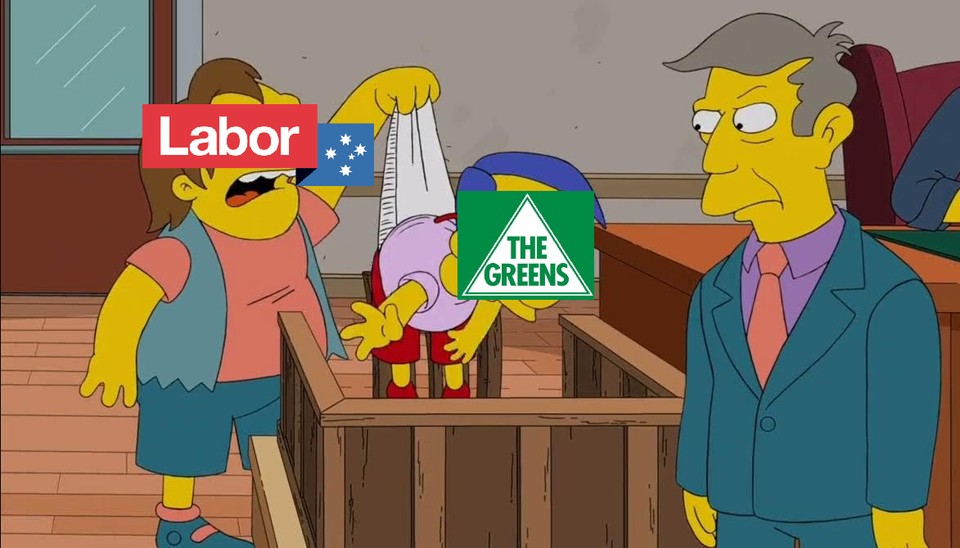
What should members of parliament do when they're forced to choose between multiple crappy options?
A good starting point would be to seek the opinions of people who aren't politicians.
In recent years, I've watched with consternation as the Australian Greens have struggled to navigate being wedged by Labor. Greens MPs are often among the last to recognise that "not letting the perfect be the enemy of the good" can actually amount to propping up and tacitly endorsing a very bad status quo (serious Danger's interview with Richard Denniss unpacks one recent example of how messy this can be).
So with David Shoebridge stepping up as leader, I thought it timely to unpack why Greens MPs should consider normalising the use of mass direct voting – initially of party members and ultimately the broader public – when deciding their position on controversial parliamentary votes. This is an important step towards transforming our fundamentally broken political system.
Representative parliamentary 'democracy' entrenches disengagement and enables state capture
Currently in Australia, you vote every few years, and between elections you essentially have to cross your fingers and hope politicians will do the right thing.
You can sign petitions, email MPs, and maybe even join a protest or participate in some kind of 'community consultation.' But there's no way of knowing how much weight the politicians will give to your views, and whether it's worth your time.
So you disengage. Why bother understanding complex policy questions when those in power seem disinterested in your opinion?
This disempowerment fuels the bigger cycle of political apathy that's created space for far-right reactionaries and corporate lobbyists to hijack and manipulate public opinion... Most Australians aren't in the habit of reading political theory or talking politics with our friends. Consequently, on the rare occasions that a politician or government department does actually care what the public thinks about something, we lack sufficient background knowledge to reach well-informed opinions, and become susceptible to propaganda.
As David Graeber has highlighted, "What we are experiencing today is not a crisis of democracy but rather a crisis of the state." The very structure of so-called representative 'democracy' entrenches disempowerment and disengagement. Graeber echoes many other political theorists in arguing that this was in fact a key reason representative parliamentary systems were established in European states and their colonies – as a more elite-friendly alternative to direct, participatory democracy systems.
This flawed representative parliamentary system means that even when elected politicians aren't intentionally corrupt, and genuinely aspire to serve the public interest, they routinely run into the following three problems...
- They can't reliably distinguish advocacy that reflects popular sentiment from advocacy by well-organised, privileged minorities and self-serving industry lobby groups.
- Public opinion has been directly manipulated by privileged elites or industry lobbyists to the extent that even when politicians know a particular policy proposal is deeply flawed, they feel they can't persuasively contradict the dumb (but widely-supported) idea without losing seats.
- Large companies that are unhappy about a policy can credibly threaten politicians with some form of capital strike – e.g. shutting down a factory that employs lots of people – forcing political decision-makers to choose between sudden, mass job losses or backing away from a proposed reform.
My seven years as a city councillor showed me how common these challenges are. Unfortunately, the Greens' laudable position of refusing campaign donations from big business doesn't magically resolve such issues.
As a politician, you can't credibly claim to 'represent' your constituents interests because you don't actually know what all your constituents want or need, making you more susceptible to getting wedged.
When your electorate is home to tens of thousands of residents, or in the case of an Australian federal MP, upwards of 150 000 residents, you simply don't have enough hours in the week to hear directly from everyone you represent about the issues that matter to them. So you come to rely heavily on the perspectives of highly motivated sub-constituencies and on leaders of local organisations, even if those organisations (whether a sports club or an environmental NGO or a chamber of commerce) aren't necessarily very democratically representative themselves. You might also rely on the advice of public servants who are often just as privileged and disconnected from ordinary people as you are.
Consequently, when people start emailing you to advocate particular perspectives or insist that you should vote in favour of a certain proposal, you can't easily tell a) whether those emails reflect broader public opinion, or (b) whether the people contacting you have themselves been swayed by propaganda, or are in fact correct in what they're saying.
In short, a representative parliamentary system structurally amplifies establishment voices and interests, and disconnects ordinary people from their MPs.
This is why many of the activists who originally helped establish the Greens were so keen on 'doing politics differently' via grassroots participatory democracy.
Participatory democracy is an ongoing practice – not just an ultimate destination
The term 'participatory democracy' covers a range of processes, from citizens' assemblies to participatory budgeting, that revolve around people having direct control over the decisions that matter to them (rather than ceding power to a representative who can't be held accountable between elections). The term generally evokes a less adversarial, more deliberative approach to decision-making, but the crucial element is that decisions are made by everyone who wishes to participate – not just small numbers of elected reps.
Part of the justification for participatory democracy is that while subject matter 'experts' might know a lot about a specific policy area, everyone is a product of their life experiences, cultural contexts and the political forces that have shaped them, and can't fully transcend their existing biases and preconceptions. No individual or small group of experts can ever have enough information and analytical capacity to accurately predict all the ramifications of a particular top-down policy change. This is reflected in Irish writer George William Russell's aphorism "experts ought to be on tap, and not on top."
So in contemporary contexts, participatory democracy aims to draw on the wisdom of the crowd to critically evaluate and validate the advice of specialist public servants and 'independent' experts.
Participatory democracy was the norm in numerous societies throughout human history and is commonly practiced in many organisations across Australia. The consensus-based processes the Greens use to update the party's state and federal policy platforms can reasonably be described as a form of participatory democracy.
But the most consequential decisions Greens MPs make – how to vote in parliament on government bills – routinely marginalise the party's thousands of members and supporters. Those decisions are made in private meetings behind closed doors.
The problem: if your long-term goal is to decentralise decision-making and transition away from a representative system that concentrates power in the hands of a small, elite group of politicians, you can't just wait until some future date when you win majority control over government to change everything.
In practice, shifting towards a participatory democratic approach to governance requires engaged, informed communities whose members have enough time and space in their lives for deliberation and dialogue, are well-practiced at patiently listening to differing perspectives, and can think laterally to generate solutions that everyone can at least live with (even if those solutions aren't unanimously, enthusiastically supported).
If you flicked a switch overnight to give everyone direct control over top-level government policy, you'd likely find that the majority of citizens were too ill-informed and disengaged to make good decisions about a lot of issues (but note: not all issues).
We'd conceivably see the public heavily swayed by disinformation and corporate sector propaganda, resulting in situations where most people didn't really understand what they were being asked about or the ramifications of their decision (this arguably occurred with the 2023 Australian Indigenous Voice referendum).
So if the Greens' end goal is a society where far more decisions are made collectively by ordinary people – rather than by elite politicians who are being manipulated and threatened by big corporations — the party needs to normalise mass participation in significant decisions now, before we win government.
In jurisdictions where the Greens have won significant governmental power without first building a robust participatory democracy culture – such as in the ACT parliament and certain local councils in Melbourne – the inertia towards centralisation of power has meant that in practice, Greens ministers and mayors have acted more like major party politicians, running public consultations about some issues but always making the biggest, most important decisions themselves behind closed doors.
We have to reverse that pattern.
Lessons from practical trials
During my two terms as a city councillor, I experimented with a range of participatory democracy processes, some of which are documented in this journal article. Most of these processes were open to any member of the general public, rather than restricted only to Greens members or supporters.
Importantly, in addition to direct voting, the processes always involved me publishing a lot more information than councillors usually share, and encouraged dialogue between residents rather than just prompting people to privately send me their feedback (side note: one of the best questions a discussion facilitator can ask is "Does anyone who hasn't spoken yet have something they'd like to share?")
 Jonathan Sriranganathan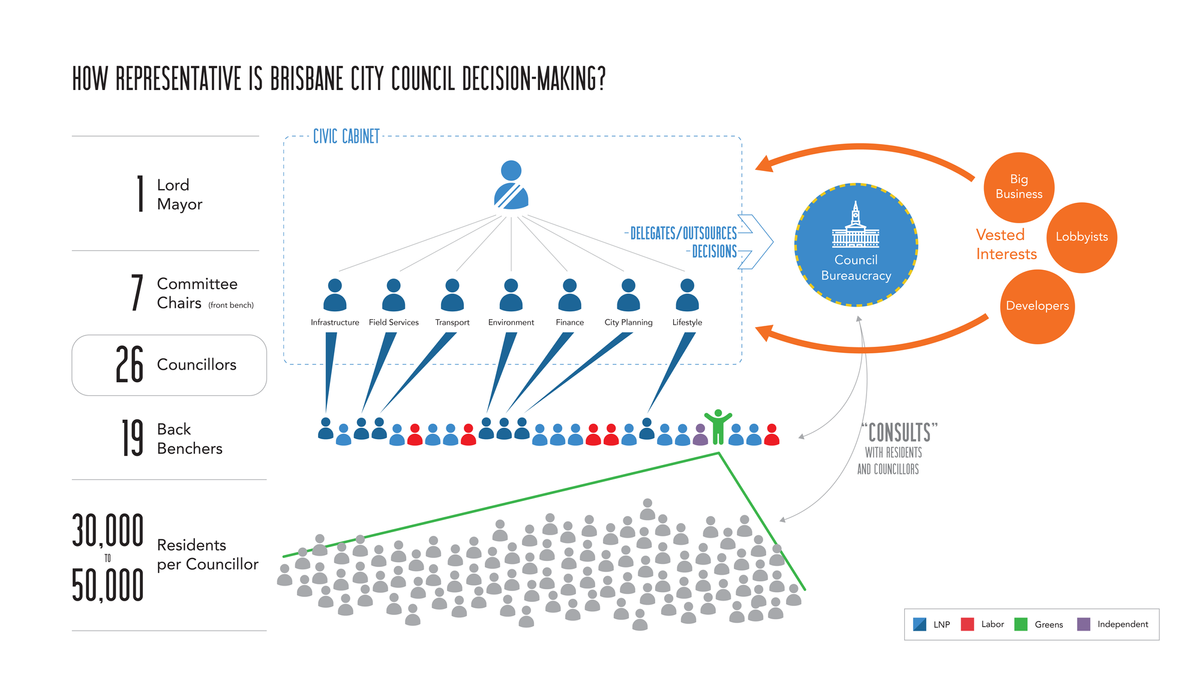
Some key lessons from these trials included:
- engagement rates are higher when a participatory process has a direct, transparent impact on a tangible outcome e.g. a direct community poll (where every participant's vote has equal weight) generates more participation – including more informed debate between residents – than a closed survey where it's not clear how much weight responses carry
- similarly, if a Greens politician doesn't hold balance of power on a particular issue, fewer constituents are likely to meaningfully engage in participatory processes to influence how that representative should vote
- building trust takes time, thus low initial participation rates aren't a serious concern – when people vote for something and see it delivered/enacted, they're more likely to encourage friends to participate in future voting rounds
- unsurprisingly, the bigger and more significant a decision is, the more people tend to participate
- the majority view at an in-person public meeting doesn't always reflect broader community sentiment across a suburb, particularly when certain privileged demographics are more likely to have the time to be able to attend meetings
For me as a councillor, democratising how I made decisions about local issues – such as how to allocate my $500 000/year discretionary budget for public space upgrades – led to better quality outcomes than if those decisions were just made by me and my staffers based on requests from the small proportion of residents who proactively contacted my office unprompted.
All of these processes had their limitations and imperfections, but they were certainly better than the status quo alternative – a politician just making unilateral decisions about whose views to ignore and whose views to give weight to.
Queensland Greens Member Poll Trials
In 2023, Queensland Greens MPs Amy MacMahon and Michael Berkman were grappling with how to vote on a Labor bill that criminalised coercive control in intimate relationships.
While the bill was supported by many domestic violence support services and women's rights groups, it had also been critiqued by several well-respected organisations.
As Greens MP Amy MacMahon said in an email to members, "The Greens don’t currently have the numbers in the Queensland Parliament to force more investment in primary prevention, frontline services, first responder training out of the government, or any amendments to the Bill. We will be faced with the decision as to whether we support or oppose the Bill as it is."
So Amy and Michael provided members with as much information as they could about both the bill and the political landscape, and ran a 'survey' (essentially a single-question non-binding poll) asking members what they thought about it.
194 members voted in the poll. A clear majority suggested the Greens should support the bill despite its deficiencies.
Strictly speaking, a non-binding member poll isn't really participatory democracy, as the MP is still making the final decision. But it's still an important step in building member engagement and a culture that acknowledges politicians aren't the only people whose judgement matters.
The polling process had a couple of limitations: Most significantly, while the survey form prevented multiple responses from the same IP address, if someone had really wanted to skew the results by voting multiple times, they could change their IP address, or just open the form on a new device to vote a second time.
Nevertheless, as Amy explained in a discussion with me last year, the clear result gave her confidence to support the bill despite the conflicting submissions from different stakeholders.
Fast-forward to 2026, and as a volunteer with the Queensland Greens Participatory Democracy Circle, I've been supporting Greens MP Michael Berkman to trial polling members about other parliamentary decisions where the existing policy platform doesn't provide clear guidance...
This year, Queensland Labor introduced a bill proposing a government-enforced cap on fuel price increases – petrol stations would be prevented from charging a price for petrol or diesel that's more than 5 cents higher than yesterday's lowest price.
The mechanism aims to flatten out sudden spikes in petrol prices, thereby easing cost of living pressures. But how well it would work in practice to put downward pressure on prices is debatable. There's also an argument that higher prices are encouraging businesses to shift towards electric vehicles, whereas keeping petrol cheaper undermines the Greens' climate action goals.
The Queensland Greens don't have a specific policy on fuel price caps. So ordinarily, Berkman and his staff would decide by themselves whether parliamentary strategy arguments and general Greens values weigh in favour of supporting or opposing Labor's bill. But for this issue, Michael agreed to run a non-binding poll.
For the poll, we used a new, open-source voting platform called Votekit (purpose-built by a Participatory Democracy Circle volunteer). Unlike the previous coercive control survey, Votekit allowed us to generate unique voting links to email to each Greens member, guarding against duplicate voting while ensuring that even the administrators couldn't see how any particular member voted.
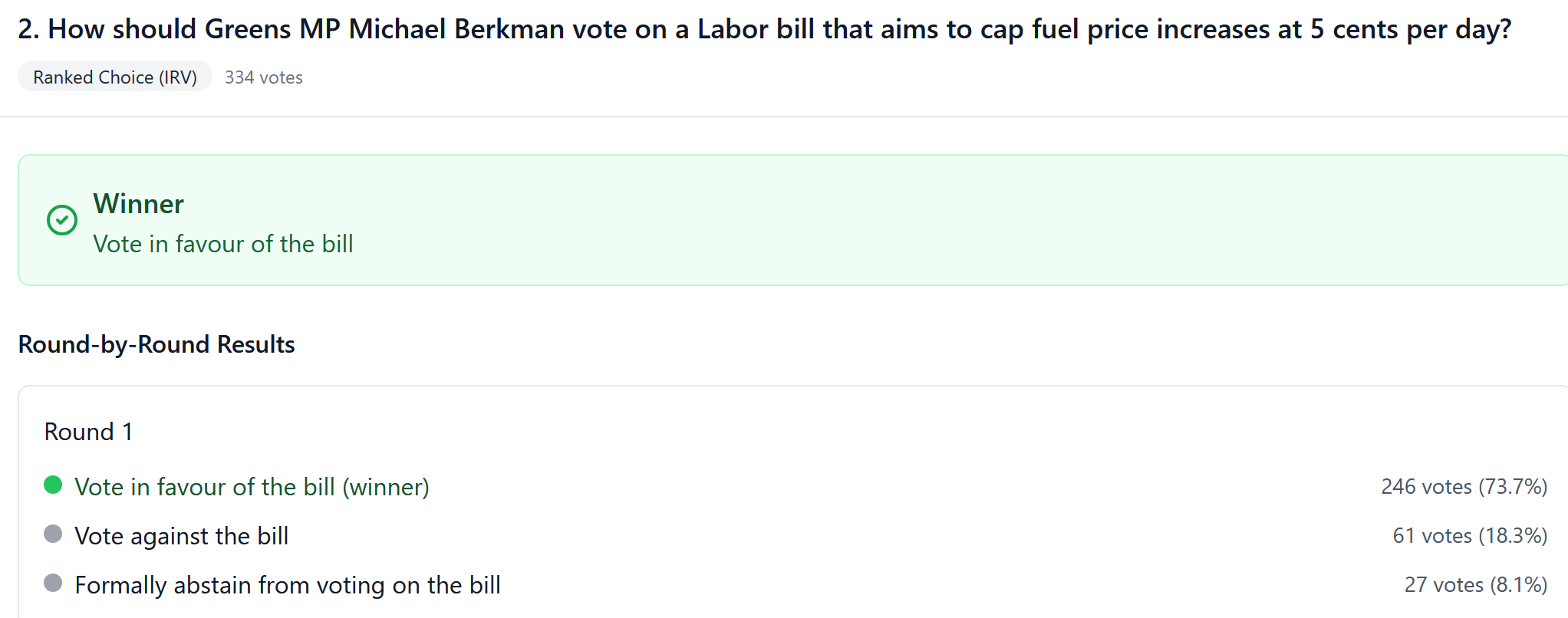
Michael asked members two distinct questions – the first focused on support for the general principle of government-enforced fuel price caps; the second specifically addressed whether Michael should support Labor's 5 cents cap proposal.
The second question also included the option of Michael formally abstaining from voting on the bill in parliament, and was set up as a preferential vote, meaning respondents could choose 'abstain' as their first option but still signal how they'd prefer Michael to vote if there was minimal support for abstaining.
The poll text and results summary are publicly available at this link.
This approach of separating the policy principle from the strategic question of whether to support Labor's specific bill ensured a more informative result. It meant respondents could, for example, signal that they opposed the idea of fuel price caps but still thought Michael should vote for the bill on electoral grounds. Or they could indicate support for the general principle of capping fuel prices while believing Michael should oppose Labor's specific proposal (perhaps because it wasn't well-structured or didn't go far enough).
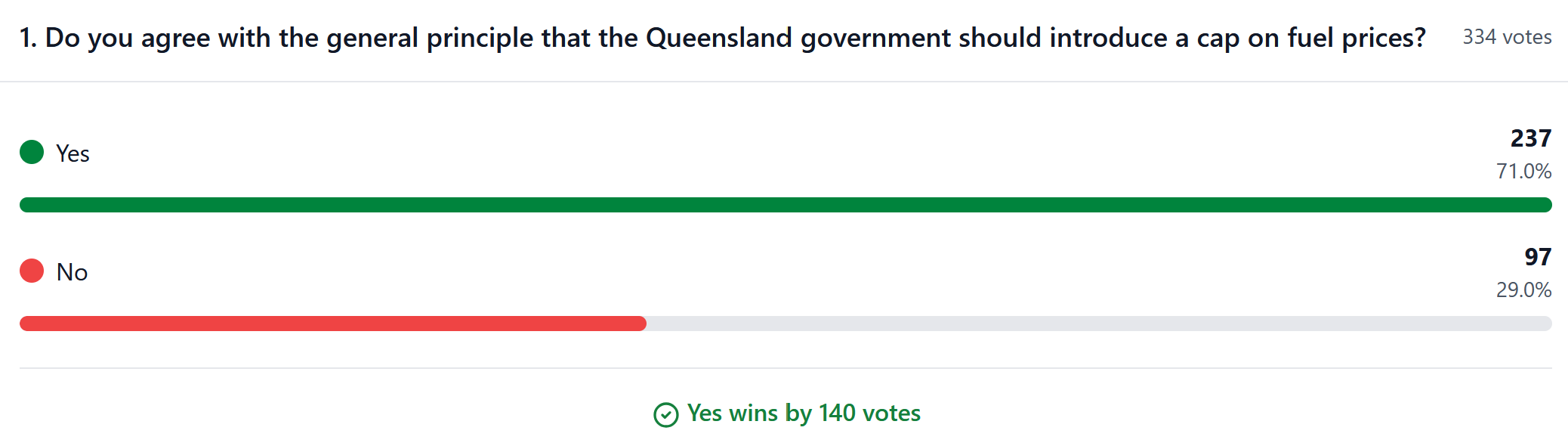
The results revealed a strong majority of participating Greens members supported fuel price caps. Interestingly, while 29% of respondents did not agree that the Queensland government should introduce a cap on fuel prices (the first question), only 18.3% of respondents said Michael should vote against the bill (the second question) suggesting that some members who opposed fuel price caps nevertheless felt it would be unstrategic to vote against the Labor bill in the current political climate.
As I'd observed in the community voting trials I ran as councillor, asking people what they thought via a voting process where everyone's views carried equal weight prompted some members to seek out and share opinions, partly in the hopes of influencing how others would vote. Members posted in Facebook group chats and other channels, asking questions and debating various arguments for and against Labor's bill.
So the poll didn't just lead to a bunch of individuals mindlessly voting in isolation from one another – it also prompted more collective deliberation and discourse. If Michael had held the balance of power on this issue in parliament, I think we would've seen even more of this kind of member-to-member discussion, which in turn would've contributed to more members voting in the poll itself.
Reflections on participation rates
2013 Queensland Greens members were emailed a unique link to vote in Michael's poll, which was open for just over 3 weeks (a reminder email was sent a few days before the poll closed). 334 members actually voted – a participation rate of 16.6% (mail server data suggests only about 1000 members actually opened the emails from Michael, so you could argue it was more like a 33% participation rate among those who actually heard about the poll).
The stakes for this poll were fairly low. Labor's fuel price cap proposal is unlikely to pass in Queensland's majority LNP parliament, and there's been little public debate about it. Several Greens members told me they didn't vote simply because they didn't have a strong opinion on the issue. In that context (and keeping in mind the lessons from my own community voting trials), a turnout of 334 is very respectable.
It's worth noting that despite the short 3-week timeframe, far more members have at least had a say on this question of fuel price caps than they have for the majority of official party policies (the Queensland Greens rarely get more than 100 members across the state meaningfully engaging with the time-intensive policy review discussions that occur in branch meetings, policy workshops and state council).
An occasional criticism of member polling is that Greens MPs shouldn't give weight to the views of the small proportion of members who engage with a poll because they might not be 'representative' of the membership as a whole. But no such criticism is offered of the party's policy workshop processes, where certain demographics (such as time-rich retirees) are frequently over-represented, nor are concerns about representativeness raised when members vote on far bigger questions, such as preselecting our lead senate candidates.
When deciding how to vote on an issue like fuel price caps, Michael Berkman doesn't have access to any additional relevant information that other Greens members can't read for themselves (except perhaps a small smattering of emails from the public). And the substantial time demands on a minor party MP mean that compared to most other Greens members, Michael does not, in practice, have more time in his week to read public submissions or 'expert' commentary on individual bills.
So while several hundred members voting in a poll falls far short of where the party should aim to get to, it's still preferable to the status quo alternative of a lone politician making such decisions unilaterally.
Looking ahead
We now have multiple successful Queensland case studies demonstrating that there are no technological barriers to our federal MPs conducting non-binding polls of the Australian Greens membership to inform their approach to controversial balance of power decisions (or, for that matter, polling members at short notice before choosing new leaders). It would even be possible to structure a poll to reflect scenarios where substantive Greens amendments to a bill were or were not accepted.
The most recent trial with Votekit shows we can do this for free in a short timeframe, in a way that satisfactorily guards against fraud (and without onerous security checks that become barriers to participation).
When minor party politicians take controversial positions – such as blocking a government bill – one of the most effective rebuttals to accusations of extremism and obstructionism is to demonstrate that they're democratically reflecting the view of thousands of ordinary people. It's harder for political opponents to smear you as a fringe minority when you're doing what lots of other people asked you to do.
 Jonathan Sriranganathan
Taking guidance from mass polling can also neutralise corrosive rivalries within party rooms full of strong egos, and provide MPs cover from disgruntled supporters who might otherwise endlessly rehash parliamentary strategy debates.
If polling the Greens membership about parliamentary voting decisions became more commonplace, this would give supporters around the country a more compelling reason to join up as party members. And the more members who vote in such polls, the more weight MPs will be inclined to give the results, counter-balancing the influence of lobbyists, centrist 'experts' and so-called 'peak bodies.'
This would be a more equitable and transparent way to handle conflicting views within the party than the default norm, which is that various individuals and working groups privately pressure MPs directly, without making serious attempts to facilitate deliberative, well-informed dialogue between larger numbers of ordinary members.
As these are non-binding polls, there's no legitimate argument that the party is unfairly elevating the views of party members above the tens of thousands of constituents in the MPs' electorates – the wider public can still lobby their MPs as usual.
Extending participation beyond party members is more challenging. It's easy to guard against duplicate voting when you're using the party's existing database to send members unique voting links. The Greens database is accurate enough that it would even be possible to email the tens of thousands of people who donated to or volunteered for the party in the last election campaign, and feel reasonably confident that very few – if any – supporters were being sent multiple links.
Scaling up polling to every member of the general public while guarding against bots and bad faith attempts to cast multiple votes is much more time-intensive. But it's still worth aiming for.
Imagine if, next time Greens MPs are deciding whether to support a controversial government bill that doesn't go far enough in addressing an urgent issue like global warming or housing precarity, the party could point to results of a public plebiscite where hundreds of thousands of Australians had voted for the Greens to hold out for bigger changes, rather than capitulating to Labor's centrist tinkering.
What I'm talking about here is a fundamentally different approach to electoral politics – involving (and educating) the public not just every few years at election time, but in an ongoing participatory movement that shifts political culture and empowers people to directly influence outcomes in parliament.
Mass voting is not the end goal, but it's an important ingredient for transforming governance systems and wider society. At a time of widespread cynicism and disengagement from politics, this is a crucial tool for building a movement that can honestly claim to be 'doing politics differently.'
It's a small step in the grand scheme of things. But we might as well give it a try.

A crucial weakness of progressive political movements in Australia is that relatively few people are producing in-depth strategic analysis and commentary (apart from shallow 'hot takes' by mainstream media personalities who clearly don't know much at all about how parties like the Greens work in practice). So if you want people like me to write articles like this, please support this work financially if you can. Sign up for a $1/week subscription...

Member discussion